At dawn on April 9th, 1940, darkness fell over northern Europe. Operation Werubong officially began. Nazi German forces simultaneously invaded Denmark and Norway, launching one of the coldest and most precisely executed occupation campaigns of World War II. Denmark collapsed after only 6 hours.
A nation was subdued with almost no time to react. Norway was different. Resistance lasted nearly two months, fought among mountains, snow, and fragmented but determined defenses. Even so, by June 10th, 1940, Norway was forced to surrender, opening the way to a prolonged occupation. Germany’s objective was never limited to territory.
Denmark was turned into a military springboard. Norway became a chain of critical naval bases, both threatening Britain directly and protecting the transport route of iron ore from Sweden, the vital fuel of the German war machine. To control Norway was to control the heartbeat of the war in Northern Europe. After the occupation, the Gestapo appeared.
Prisons, interrogations, and arrests spread. Fear was organized, measured, and sustained as a system. Yet the most effective domination did not come from German officers in uniform. It came from Norwegians themselves, people who betrayed their own countrymen. Alongside the far-right party Nazol Samling, there were collaborators even more dangerous.
They did not represent ideology. They represented infiltration. They understood Norwegian society, spoke the same language, shared the same anxieties, and exploited them to hunt people from within. One of them was Henry Renan, a small, insignificant man with no official authority. Yet the figure behind a dense network of informants, posing as resistance while feeding on the blood of his own people.
For Reinan, enemies were not destroyed on the battlefield. They were led into traps through their own trust. The German occupation brought weapons and conspiracy. But the darkness Renan spread began with something far more fragile. Trust between human beings. Portrait of a failed man.
Henry Renan was born on May 14th, 1915 in Levvena, central Norway. He was the son of a shoemaker. The family was poor but stable, not lacking food with no signs of violence or severe instability. This background rules out the explanation that Renan’s later path was the result of coercive circumstances.
In appearance, Renan was short, standing only about 1.59 m tall, but he did not withdraw. On the contrary, he dressed neatly, communicated well, and made a favorable first impression. Many remembered him as confident, personable, and easy to get along with. This social exterior was important, allowing Renan not to be seen as an outsider in his early years.
Renan’s youth was relatively uneventful. His academic performance was above average. He caused no trouble and was regarded by teachers and classmates as likable. There were no early signs of extremist leanings or deviant behavior. On the surface, Renan was an ordinary Norwegian young man before the war.
The fractures appeared when he entered working life. The first serious failure occurred at a sporting goods store where Renan was dismissed for misappropriating sales money. The offense was not large, but it was enough to end his position. This was a personal choice, not the result of social pressure.
The second failure was more serious. While working in automobile sales, Renan ran away with a mistress for two weeks at the very moment his wife Claraara was giving birth to their first child. This act not only cost him his job but also destroyed his personal credibility within the community. From that point on, Renan began to be seen as someone untrustworthy.
After that, he worked as a truck driver. The job sustained his life but brought neither status nor recognition. In a society that valued discipline and responsibility, Renan increasingly accumulated a sense of being looked down upon, not because society excluded him, but because he repeatedly undermined his own position.
The psychological turning point came during the Winter War of 1939 to 1940. Renan applied to join the Finnish army, hoping to gain recognition and assume a role of value. He was rejected due to inadequate physical fitness and the use of upper dentures. This refusal was symbolic. It marked the final failure of his attempt to seek recognition within normal social frameworks.
From that moment, Renan developed the mindset of a man who craved significance, but refused to accept his own limits. He did not seek to correct his course or improve himself. He waited for another path. When war erupted and social order collapsed, people like Renan did not stand aside.
They sought opportunity and chaos. A space where power came not from competence or honor but from a willingness to cross boundaries. The choice of a traitor. When Nazi Germany launched its invasion of Norway on April 9th, 1940, Henry Rinan did not stand among those who resisted.
He also did not immediately choose the side of the occupying power. In the early stage, Renan did what he knew best. He worked as a truck driver for the Norwegian army. It was a low-level logistical position with no authority and no influence. Once again, Renan stood on the margins of the major events that were shaping the country.
After Norway surrendered on June 10th, 1940, the old order collapsed rapidly. A new power structure emerged under German control, and with it came an urgent demand for local personnel. The Gestapo needed people who understood Norwegian society, spoke Norwegian, and could reach underground networks that German soldiers could not access.
In that context, Renan became a suitable choice. He had no social status to lose. He possessed experience in personal interaction, an ability to build rapport, and a deep need for recognition. In June 1940, Renan was recruited by the Gestapo. This was not the result of coercion. It was a deliberate decision.
To understand the depth of this betrayal, it must be placed against its opposite force. At the time, the Norwegian resistance movement was gradually forming and expanding. On the military side, the Milorg organization carried out sabotage, gathered intelligence, and built forces for a future uprising.
Alongside this was civil resistance, including underground newspapers, strikes, and networks that helped Jews and other persecuted individuals escape to Sweden. From abroad, Britain supported covert operations through the SOE, including well-known missions such as the sabotage of the heavy water production facility at Vmorgg.
It was precisely within this growing yet fragile resistance environment that Renan began his new role. In the initial phase, he operated alone without collective authority. By the end of 1941, Renan was assigned to infiltrate left-wing groups in Tronheim. Using the alias Fiskvik, he approached targets, built relationships, and gathered information in a systematic manner.
Results did not appear immediately, but accumulated over time. Through fabricated connections and patience, Renan directly contributed to the arrest of approximately 50 to 60 individuals linked to the resistance. This marked a critical turning point. From an isolated informant, Renan demonstrated his practical value to the Gustapo.
At this point, Renan’s choice became irreversible. He was no longer merely providing information. He began shaping methods to identify and capture people from within the resistance itself. The power he had once sought in ordinary society now appeared in a different form, tied to the occupation and the German security apparatus.
From here on, Renan’s path was no longer about adapting to survive, but about deliberate escalation in the role of betrayal. The Renan gang and the game in the dark zone. By the end of 1941, Henry Rinan was no longer an isolated informant. He had proven his effectiveness to the Gustapo in Tronheim.
This led to an organizational escalation. In January 1942, a special unit was established under the direct sponsorship of the Gustapo known as Sundarab Tailong Lola. In practice, this was Renan’s gang operated by Norwegians and serving the German security apparatus. Lola quickly expanded to 50 to 60 members, most of them Norwegian citizens.
They did not wear German uniforms. They blended into everyday life, moved freely, and accessed spaces that occupying troops could not penetrate. In terms of authority, the unit functioned as an extension of the Gestapo in Tronheim, operating under the direction of Ghard Flesh, who held decisive power in the region.
Renan regarded flesh as a model of authority and used that protection to broaden his reach. From September 1943, Lola relocated its base to the house at number 46 Yonvans, a secluded and discrete location. The site was converted into an operational center for the network with holding rooms and interrogation spaces within a residential setting.
This was not a public facility, but a closed environment where power was exercised outside any normal system of oversight. Renan implemented what he called provocation operations, a psychologically driven infiltration strategy. Members approached civilians on buses, in cafes, and at workplaces.
They expressed hostility toward Germany, complained about the occupation, and shared familiar grievances. The goal was not coercion but the creation of a sense of shared understanding. From these scattered contacts, Renan went further. He created fake resistance groups. Recruits believed they were joining the struggle against the occupation.
They were given small tasks connected to supposed comrades and led to feel they were contributing to a larger cause. In reality, the entire network was under Lola’s control. When the lists grew long enough and relationships were firmly established, the trap closed. Participants were separated, arrested, and then disappeared from public life.
There were no largecale raids, no shows of force. Arrests occurred quietly, one person at a time, in deliberate silence. Those taken were not brought before public courts. They were interrogated in isolation, subjected to prolonged questioning, and then shot or hanged by administrative decision. Families received no notification.
Names gradually vanished from records and public space. After each wave, trust within the resistance community eroded severely. No one was certain who was genuine and who was a trap. Confusion became the most effective instrument of repression. Renan’s power during this period was nearly absolute within the gang.
He regarded himself as the law. Anyone suspected of disloyalty, whether a lover or a collaborator, could be removed from the network. The case of Kitty Grande, a lover who also provided information illustrates the degree of Renan’s personal control. When she developed a relationship with a resistance fighter, Renan viewed it as a threat and immediately expelled her from his circle of protection.
In Tronheim, Lola’s presence created a prolonged state of instability, not because of public actions, but because anyone could potentially be part of the trap. This was the phase in which Renan did more than serve the Gustapo. He shaped a method of repression based on breaking social trust, weakening the resistance from within.
Crimes and the final escalation. From 1942 to early 1945, the network run by Henry Renan reached its highest level of activity. Lola was no longer a loose infiltration group. It became a continuously operating mechanism with a steady rhythm of arrests, interrogations, and transfers.
According to postwar records, the activities of this group were linked to 83 deaths, more than 1,000 coercive interrogations, and approximately 1,000 people sent into the German detention camp system. What stands out is not only the numbers, but the ripple effects. Each wave of arrests did not end at the moment it occurred.
It left behind gaps, suspicion, and silence within the community. Resistance groups were forced to limit contact, cut communication channels, and delay operations. Renan’s fake resistance trap did not need to be repeated constantly to remain effective. The mere possibility of its existence was enough to paralyze Trust.
By late 1944, the course of the war was shifting rapidly. Germany was retreating on multiple fronts. In Norway, Gestapo control gradually weakened. In this context, the behavior of Renan and Lola did not slow down. Instead, it became more closed and increasingly personal.
As the system that protected him began to falter, Renan focused on preserving internal control. In April 1945, only about 2 weeks before Germany surrendered, Renan personally eliminated two members of his own group, Marie Arence and Bjun Bernabo. The motive did not come from Gustapo orders, but from suspicion, jealousy, and fear of abandonment.
This was a clear sign that Lola had shifted from an instrument of repression into a closed structure where Renan’s personal power stood above all political objectives. These final actions no longer served the occupation strategy. They reflected the collapse of a man who had tied his entire sense of worth to power in the shadows.
When the system that sustained him fell apart, Renan did not withdraw. He narrowed the circle, increased internal control, and removed any possibility of betrayal from within. This phase marked the end of Lola as an effective instrument. It no longer expanded. It contracted inward, operating on internal fear.
That contraction signaled something unavoidable. Collapse was approaching. the collapse and the failed escape. In early May 1945, the occupation order in Norway disintegrated. Germany surrendered. The system of protection that Henry Rinan depended on vanished within days. For Reinan, this was not a moment to maintain control.
It was time to disappear. He and several remaining members of Lola prepared an escape plan. The method was simple, but reckless. They wore German uniforms underneath civilian clothing and blended into groups of German soldiers being repatriated. The goal was to leave Norway amid the chaos, carrying cash and weapons to secure their survival.
The plan failed quickly. On May 15th, 1945, Renan was arrested with luggage containing money and firearms. There was no firefight. There was no prolonged pursuit. He was identified and pulled from the crowd in the first days after the war. At the time of his arrest, Renan’s lover was pregnant.
She immediately denied the relationship, cut all ties, and terminated the pregnancy while Renan was already in prison. For him, this marked the complete collapse of a personal circle that had already narrowed before the war ended. On Christmas night in 1945, Renan made one final attempt to escape.
He broke out of prison with the intention of moving east toward the Soviet Union. The escape lasted only about 1.5 hours. Renan was recaptured in a state of exhaustion, bringing any chance of flight to an end. Public anger in Norway was now fully visible. As Renan was escorted through a crowd, people closed in around him.
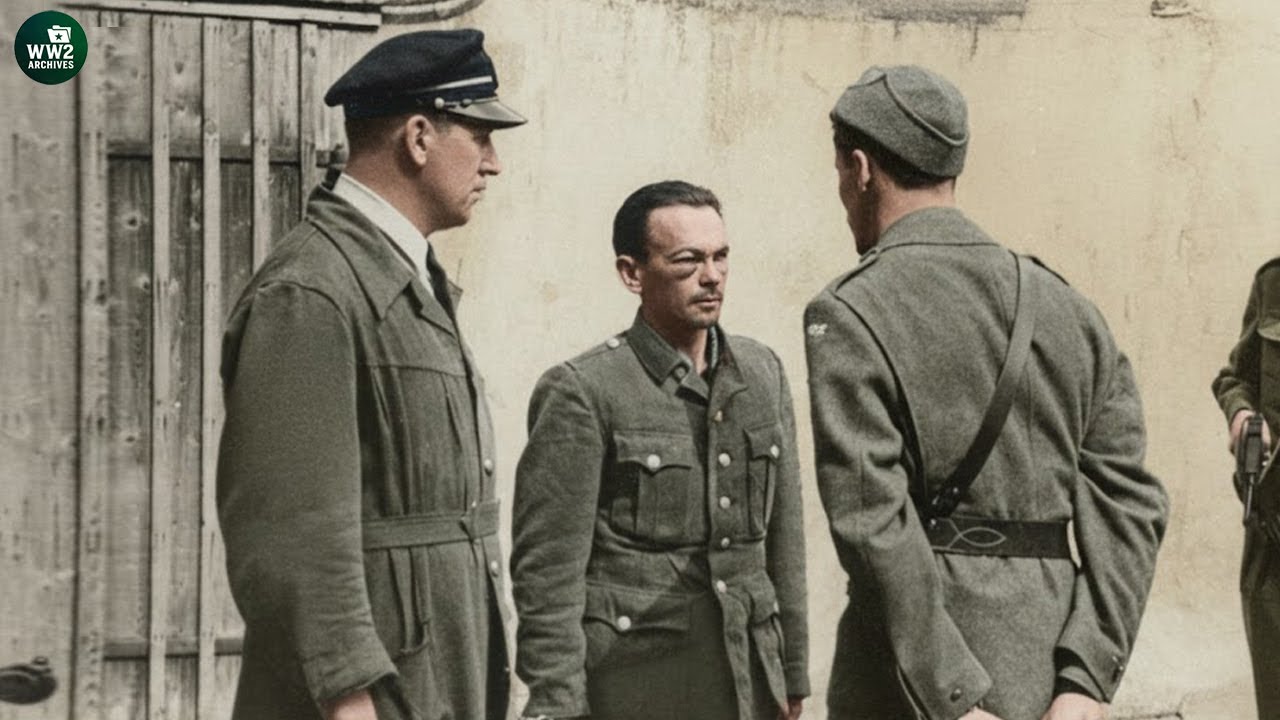
In a moment of chaos, one person pushed past the police line and punched him in the face amid cheers. This was not an organized act. >> >> It reflected a social mood shaped by years of betrayal from within. In prison, Renan no longer held any special status. He was treated harshly, his face swollen during interrogations under pressure and in an attempt to reduce responsibility.
He cooperated with the police, identifying Gustapo personnel and collaborators still in hiding. In some cases, he allowed them to pass and then called them back, an act of bitter irony toward those who had once used him as a tool. This period closed the image of a man who had once operated in the shadows.
When the system collapsed, Renan had no network, no power, and no one standing between him and justice. All that remained were files, testimonies, and the waiting for an unavoidable trial, judgment, and a cold ending. After months of investigation, and the collection of testimony, the Norwegian justice system entered the phase of judgment.
The postwar chaos was gone. The gray zones of power had disappeared. The case file on the Lola gang was reconstructed in detail from its organizational structure and methods of infiltration to each specific victim. At the center of the entire case stood Henry Renan, the man behind a system of organized betrayal.
On September 20th, 1946, the court delivered its verdicts against the core members of the Lola gang. 12 individuals were sentenced to death. Renan himself was convicted of direct involvement in 13 deaths, even though the records showed that the true extent of his responsibility went far beyond that number.
The verdict provoked no serious dispute. It reflected a broad social consensus that these acts could not be regarded as ordinary consequences of war. The sentence was carried out at 4:05 a.m. on February 1st, 1947 at Christianston Fortress in Tronheim. Renan was tied to a post and blindfolded. Witnesses noted that he showed no clear emotion.
He made no statement. He offered no resistance. The execution proceeded quickly in accordance with postwar legal procedures. He was shot at close range. Afterward, the body was cremated and buried in an unmarked grave. No headstone, no identifying marker, no space for remembrance. This was a deliberate decision by the Norwegian state intended to eliminate any possibility of turning the perpetrator into a distorted symbol in collective memory.
But justice did not end with the sentence. It left lasting consequences for those who remained. Claraara, Renan’s legal wife, met him for the last time on the advice of a pastor. She then changed her name, remarried, and left Tronheim, leaving behind their three children. When asked about her decision, she offered only a brief reply. I have suffered enough myself.
It was not a justification. It was an admission of exhaustion. Renan’s children were not judged, but they carried his name. His son, Roar, grew up in isolation and rejection, forced to change his name and moved to Sweden to escape social pressure. This was a familiar postwar tragedy. Guilt does not pass through bloodlines, but consequences do.
The story of Henry Renan does not end with sympathy. There is no myth, no elevated personal tragedy, only a closed file and a society struggling to heal after being broken from within. Not a single tear was shed for Henry Renan. Yet the moral questions he left behind remain quiet, persistent, and difficult to answer.
From a historical perspective, what must be remembered is not the fate of an individual who has already been judged, but the conditions that allowed such distorted choices to emerge. Crises always open space for abnormal power, and in those moments, personal standards become the most important line of defense. Major tragedies rarely begin with sudden decisions.
They usually take shape through small compromises made in silence when people stop questioning their own limits. For this reason, historical education is not meant to instill fear, but to emphasize personal responsibility in every choice, even those that seem insignificant. A resilient society does not rely on laws alone.
It also depends on the capacity for self-restraint and internal criticism. When trust is built on transparent action, hidden threats find little room to grow. Learning from the past is not about condemnation. It is about understanding that in any circumstance, people retain the ability to choose a path that does not harm others.
That is the enduring value of history.
News
“I Could Not Stand”, German Woman POW Weeps When Americans Lift Her Instead
The ground is cold and uneven. Mud clings to boots and hems. Smoke hangs low and smells of burned oil…
“I Expected Screaming”, German Woman POW Stunned by the Silence of American Camps
The train slows in the gray dawn. Frost clings to the wooden planks of the cattle car. The door slides…
“Get These Clowns Out of My Camp”—Why US Command Mocked the SAS Death-Smell Until They BURIED the VC
Get these clowns out of my camp. That is the exact phrase an American colonel used to describe Australian SAS…
Wounded in Vietnam during TET 1968| Don Kaiser’s Story of War, Brotherhood, and Survival.
firing had gotten so intense it was just breaking rice straws off in front of front of our faces. You…
“We Were Starving”, German Women POWs Shocked by American Soup Pots
Late April 1945, a thin mist hangs over a shattered German town. Broken roofs drip from the night rain. A…
The Darkest Secret of Nazi Germany: The Breeding Program That Even Hitler Feared
You remember those old grainy documentaries, the ones that detail the darkest corners of the Third Reich? We often talk…
End of content
No more pages to load