They sold her for less than the price of a bottle of whiskey. In the brutal winter of 1874, in a lawless mining camp called Broken Ridge, a woman was dragged onto a makeshift wooden stage. A filthy burlap sack was tied tight over her head, cutting her off from the world. The crowd laughed as if it were a show put on just for them. Mud hit her dress.
Someone threw a rock. Men shouted cruel jokes, calling her broken goods, useless, not worth feeding. But one man did not laugh. Silas Blackwood stood at the edge of the crowd, tall and silent, his heavy fur coat dusted with snow. He had not spoken to another soul in 6 months. He lived alone, high in the Bitterroot Mountains, far from people, far from noise, far from memories.
He had come down only for supplies, salt, ammunition, flour, nothing more. Then he saw her hands. They were shaking badly, not just from the cold, from fear. Pure terror. That was something Silas recognized well. The wind howled through broken ridge like a dying animal, carrying the stink of sweat, smoke, and unwashed bodies.
The camp was nothing but leaning shacks and sagging tents pressed against the mountains like they were afraid to fall away. Hope did not live in places like this. It came here to die. Silas adjusted the pack on his shoulders and turned to walk away. Then the crack of a whip split the air. “Step right up, gentlemen.
” A slick voice called out. “Don’t be shy.” The voice belonged to Cyrus Snake Callaway, a drifter with greasy hair and a reputation that crawled like oil. He stood on an overturned crate, grinning at the crowd. Beside him stood the woman, her wrists tied, her body trembling under a thin gray dress that did nothing to stop the cold.
“What you got there, snake?” a minor shouted. “A dog or a woman?” Laughter ripped through the crowd. Little of both, Callaway said. Found her wandering near Deadwood. No name, no family. Won’t speak a word. Dumb as a fence post. Why the sack? Another man yelled. Callaway sneered. Trust me, you don’t want to see what’s under there.
Face looks like it lost a fight with a wild cat. Ugly as sin, but strong hands. She’ll work. Who starts the bidding at $5? Silence followed. $5 was too much for a woman Callaway claimed was ruined. Even lonely men had limits. I wouldn’t pay two, someone scoffed. The woman flinched, a small movement, but Silas caught it. Her shoulders tightened, her hands clenched.
She was not just cold. She was being crushed. “All right,” Callaway snapped, grabbing her arm and shaking her. “$3?” No one answered. Men began to drift away, bored. Fine, Callaway spat.$1. One silver dollar or I leave her tied to a tree for the wolves. Something broke inside Silas. He was not a hero.
He was a man who wanted peace and quiet and to be left alone. But he knew what it meant to be thrown away. He knew what it felt like to be treated as less than human. The woman stood still now, as if she had already accepted death. I’ll take her. The voice was deep, steady, and dangerous.
The crowd turned as Silas stepped forward. He was massive, broadshouldered, with a beard like iron and eyes hardened by loss. He reached into his pocket and pulled out his last silver dollar. It was all he had for the winter. The coin slapped onto a barrel. Callaway’s grin returned fast. Sold. He tossed the rope to Silas.
She’s your problem now. Don’t say I didn’t warn you. Silas did not respond. He stepped closer to the woman, blocking the wind with his body. Come on, he said quietly. Let’s get you out of this mud. The crowd mocked him as he led her away. He ignored them. The journey up the mountain was slow and brutal. Snow began falling hard an hour after they left Broken Ridge.
Silas walked ahead leading his mule while the woman rode. He wrapped his spare blanket around her shoulders. She never spoke, never thanked him, just breathed fast inside the sack. 4 hours later, they reached his cabin. A sturdy log structure built into the cliffside, surrounded by pine trees. Darkness had already fallen. Silas helped her down.
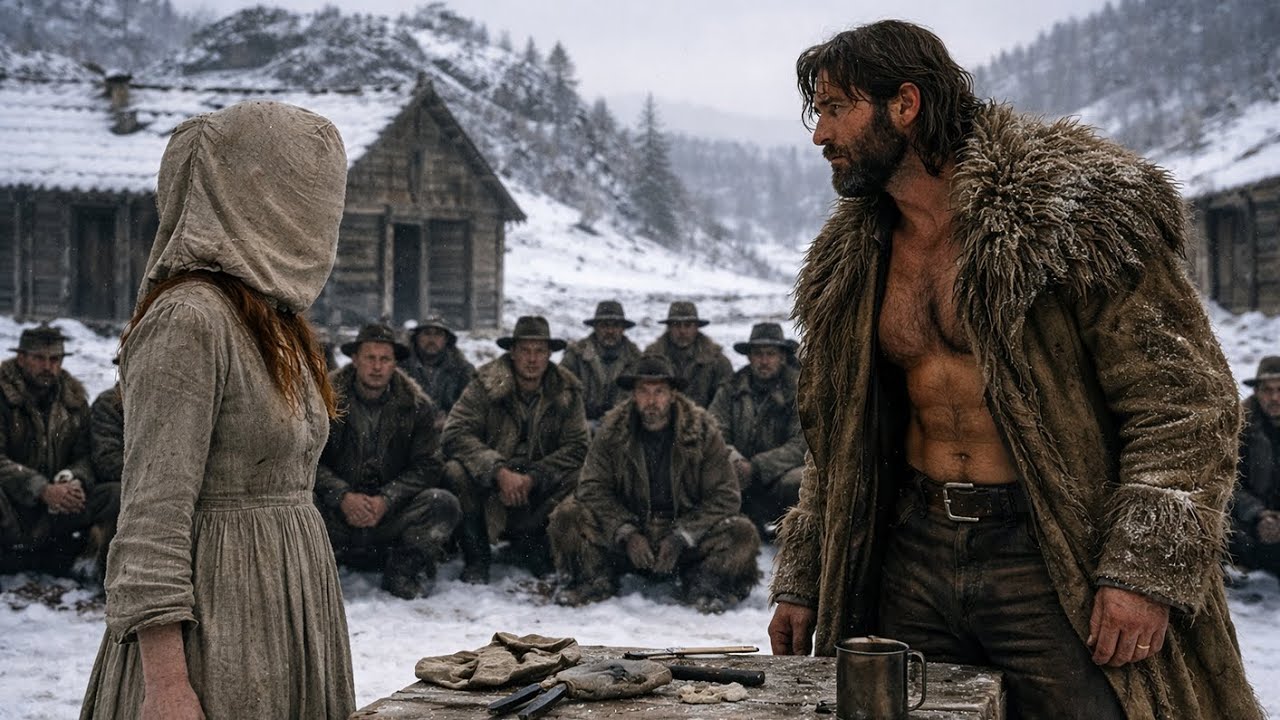
Her legs buckled, and he caught her. She was light, too light. Inside the cabin, the fire was dead in the air frozen. Sila set her in a chair by the hearth and lit the fire. Only then did he turn to her. The sack still covered her head. He pulled out his knife. She recoiled, shaking violently. “Easy,” he said. “I’m not hurting you.
” He cut the rope at her neck and reached for the sack. “Look at me,” he said gently. Slowly, she lifted her chin. Silas pulled the sack away. His breath left him. There were no scars, no disfigurement. Her face was striking, almost unreal, pale beneath the dirt. One eye was bruised and swollen. Her lips split, but beneath the injuries was a beauty that stopped time.
Her eyes were violet, sharp, intelligent. Afraid, she studied him closely. “He lied,” she whispered. Her voice was soft, educated, nothing like what Silas expected. “Who are you?” Silas asked. She swallowed, then straightened her back. “My name is Adeline Sterling,” she said. “And I have just killed the governor of Wyoming.” The fire cracked loudly.
Silas stared at her. He knew that name. Every territory did. and the snow outside kept falling, sealing them together as fate closed its grip. The silence inside the cabin pressed down harder than the storm outside. The fire popped and shifted, throwing long shadows across the log walls. Silas Blackwood did not move for several seconds.
He simply stared at the woman sitting in his chair. The burlap sack pulled at her feet like a dead thing. Adeline Sterling, the name carried weight. Wanted posters, rumors whispered in saloons. A woman accused of poisoning her husband and murdering the governor in cold blood. A $5,000 bounty. Dead or alive. Silas had just bought her for $1.
You’re the most wanted woman in the territory, Silas finally said. His voice was low. Careful men hang for less than hiding you. I know, Adeline replied. Her violet eyes did not look away. But I didn’t kill him. Silas studied her face. He had seen liars beg and scream. She was not begging. She was furious. Outside, the wind battered the cabin like it wanted in.
“You better start talking,” Silas said, pulling a chair closer. “And don’t leave out a single word.” Adeline’s hands shook as the cold and fear finally caught up with her. Silas stood, ladled steaming venison stew into a bowl, and set it in front of her along with bread. “Eat,” he ordered. “You won’t last long without it.
” She hesitated only a moment before eating like someone who had been starving. The manners of a lady fought with the hunger of an animal. Silas watched closely. When the bowl was empty, she wiped her mouth and took a breath. “The governor was my godfather,” she said. “He raised me after my parents died.
His name was Mitchell. He was not a good man. He was an honest one. Silas nodded once. My husband, she continued, her voice tightening. Bogard Sterling wanted his land. Cole lay beneath tribal territory. The governor refused to sign the papers. He refused to break peace. She stood and paced the room, the blanket trailing behind her.
At a gala, my husband poured the wine. He handed me the glass. I handed it to my uncle. He drank it. Two minutes later, he was dead. Tears spilled down her face. They planted the poison in my bag. They called me the black widow. I was the air. The story wrote itself. “How did you escape?” Silas asked. My maid hid me in a laundry cart. I walked for days.
Callaway found me near Deadwood. When he saw the wanted posters, he put the sack on my head. He knew if he turned me in, men worse than him would come. “The Red Sash gang,” Silas said. Adeline’s face drained of color. “Yes,” Silas looked toward the window. Snow had buried half of it already. “They’ll come,” she whispered.
“They always do.” Silas stood and checked the rifle by the door. “I don’t like bullies,” he said. “And I don’t like poisoners.” That night, he slept by the fire with his rifle across his knees. Adeline slept in the small back room, safe for the first time in weeks. Morning came bright and blinding after the storm.
The mountain stood clean and silent. For 2 days, they settled into an uneasy rhythm. Adeline scrubbed floors and mended clothes. Silas taught her how to load a revolver. He never touched her without reason, never looked at her like she was owned. She watched him when he thought she wasn’t looking. the quiet strength, the sadness he carried like a scar.
On the third morning, the sound of an axe stopped suddenly. Silas burst through the door, face hard. Get in the cellar now. She obeyed without question. 10 minutes later, boots crunched outside. Three men entered without knocking. Law men in appearance only. Cold eyes. One wore a red sash at his waist. We’re looking for a woman, the leader said.
I live alone, Silas replied. They searched, they threatened. They smelled lavender and fresh bread. Silas stood his ground. Eventually, they left. But Silas knew better. “They’ll wait,” he said after pulling Adeline from the cellar. “We leave tonight.” They abandoned the mule and climbed into the high pass under moonlight.
Snow swallowed their tracks. The cold was merciless. By dawn, they reached the summit. Wind screamed like a living thing. Silas led them into an abandoned mining drift to rest. “Why are you doing this?” Adeline asked softly. Silas stared at the stone wall. “I had a wife once,” he said. “Men with money burned my house.
The law laughed.” He met her eyes. “I don’t run anymore.” They moved again, descending into a narrow canyon called the throat. Ice lined the walls. A frozen creek ran beneath their feet. A rifle cracked. Bullets shattered stone. They’re on the ridge. Silus shouted. They ran. They dove behind boulders as gunfire echoed.
Silas shot back, dropping one man. Then another appeared behind them. Silas threw his knife. The man screamed. A second shot rang out. Silas fell. Silus. Adeline screamed. Blood spread fast across the snow. She grabbed the rifle and fired. The outlaw dropped. Silas gasped, fading. She dragged him toward a frozen waterfall, hiding behind the ice.
She pressed cloth to the wound. “We have to burn it,” Silas whispered. “She did.” Outside, Rock’s voice echoed. Adeline stepped out alone. She shattered the ice beneath him. Rock vanished into the freezing river. Silence returned. Adeline crawled back, wrapped herself around Silas, and whispered until he breathed again. They were not safe yet.
But they were alive. The mountains did not care who was innocent or guilty. They only cared who was strong enough to survive. Silas Blackwood drifted in and out of darkness as Adeline dragged him through the snow. His weight was crushing, but she refused to stop. She broke pine branches and tied them with strips torn from her dress, forming a rough sled.
She laid him on it and pulled with everything she had left. Her boots split apart by the second day. She wrapped her feet in cloth. She set snares like Silas had shown her and caught rabbits. She melted snow and fed him broth, spoon by spoon, whispering his name whenever his breathing slowed. Stay with me, she kept saying, you didn’t save me, so you could die now.
On the fourth day, the mountains finally opened. Below them lay Silverton. Smoke rose from chimneys. Bells rang. People moved through the streets like the world was still normal. Adeline cried as she dragged the sled into town. Men stopped. Women stared. A woman in rags pulling a giant man wrapped in blood soaked hides was not something Silverton had seen before.
She collapsed in front of the sheriff’s office. The door flew open. A man rushed out, his face going white when he saw the body on the sled. “Silus!” he breathed. Sheriff Tom Blackwood dropped to his knees, checking for a pulse. “He’s alive!” Tom shouted. “Get the doctor now.” He turned to the woman on the ground.
“Who are you?” he asked gently. Adeline lifted her head. Her face was raw and hollow, but her eyes burned. “My name is Adeline Sterling,” she said. “And I have come to collect a debt.” Silus lived. The bullet had missed his heart by inches. The cauterized wound saved him, though his recovery was slow and painful. Adeline never left his side.
3 weeks later, the courthouse in Silverton overflowed. People came from miles away. They had heard the story. The mountain man, the fugitive wife, the dollar that bought destiny. Bogard Sterling sat at the front, clean and confident, dressed like a man who had never feared consequences. Silas stood at the back beside his brother, his arm in a sling, his posture straight despite the pain.
“Call the defendant,” the judge ordered. The doors opened. Adeline entered wearing a simple blue dress. A black veil covered her face. She walked to the stand without shaking. “How do you plead?” the judge asked. “Not guilty,” she said clearly. Bogard’s lawyer sneered, calling her unstable, hysterical, dangerous. “Adeline lifted the veil.
Gasps filled the room. She told the truth.” Silas stepped forward and placed Callaway’s ledger on the bench. payments, names, proof. The jury did not leave their seats. Guilty, the foreman said. Bogard screamed as he was dragged away. Outside, Snow fell gently. “You’re free,” Silas said quietly. Adeline looked at the town, the wealth waiting for her, the life she could reclaim.
“Then she looked at the mountains.” She took out a battered silver dollar and pressed it into Silas’s hand. I want to buy something, she said softly. What can you buy for a dollar? He asked. A partner, she replied. Silas closed his fingers around the coin. Sold. They rode back into the high country together, and the mountains kept their
News
Admiral Shibazaki Boasted “It Will Take 100 Years to Capture Tarawa” — US Marines Did It In 76 Hours
At 13:30 hours on November 23rd, 1943, Colonel David Shupe stood on a two-mile strip of coral called Betio,…
Japanese Troops Were Terrified When U.S. Marines Cleared Trenches Without Letting Go Of The Trigger
On the morning of August 17th, 1942, at 0917, Sergeant Clyde Thomasson crouched behind a palm tree on Makan Island,…
Japanese Soldiers Were Terrified When .50 Caliber Machine Guns Penetrated Their Concrete Bunkers
On the morning of May 14th, 1945, at 0630 hours, Corporal Lewis Ha crouched behind a coral outcrop on Okinawa’s…
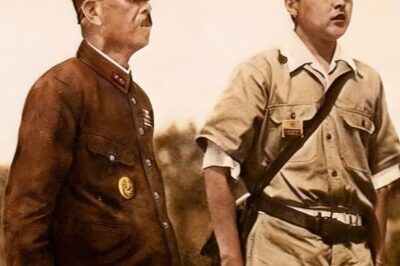
General Hyakutake Ignored The “No Supplies” Warning — And Marched 3,000 Men Into The Jungle To Die
On the morning of December 23rd, 1942, at 0800 hours, Lieutenant General Harukichi Hiakutake sat in his command bunker on…
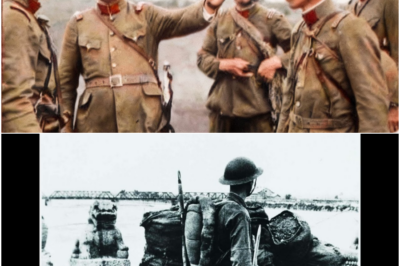
Colonel Ichiki Was Told “Wait For Reinforcements You Fool” — He Attacked Anyway And Lost 800 Men
At 3:07 in the morning on August 21st, 1942, Colonel Kona Ichiki crouched behind a fallen palm tree on the…
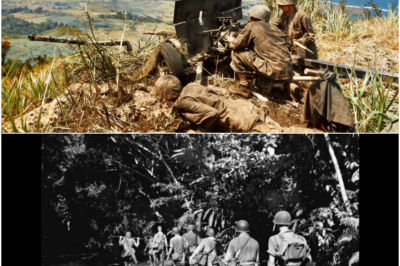
Japanese Soldiers Were Terrified When U.S. Marines Turned Anti-Tank Guns Into Giant Shotguns
On the morning of August 21st, 1942, at 3:07 a.m., Private First Class Frank Pomroy crouched behind a 37 millimeter…
End of content
No more pages to load