Late April 1945, a thin mist hangs over a shattered German town. Broken roofs drip from the night rain. A woman stands in line, clutching a dented tin cup. Her coat hangs loose on her shoulders. Her boots no longer match. She smells smoke, wet earth, and something unfamiliar. Food ahead of her.
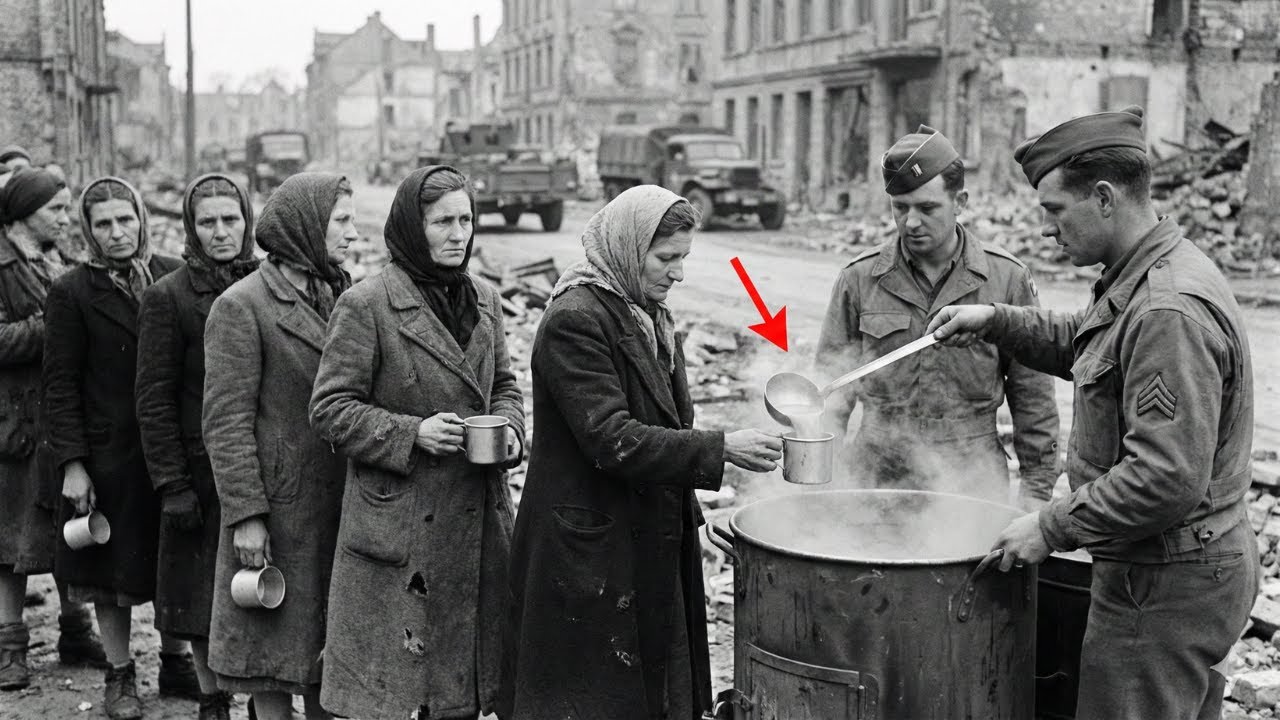
Steam rises from large metal pots. American soldiers move with calm routine. They lift ladles. They pour thick soup. The woman watches in silence. Her stomach tightens, not only from hunger, but from disbelief. For months, she has lived on scraps. Turnup peels, thin bread mixed with fillers. Now the steam curls into the gray sky, heavy with fat and meat.
She has not seen food like this since before the war. Around her stand other women, factory workers, auxiliaries, nurses, prisoners now. No one speaks. The only sound is soup hitting metal and slow breathing from people who have almost forgotten what full feels like. Germany in 1945 is collapsing from the inside.
By January, the eastern front has already torn through East Prussia and Sicia. The Red Army advances west with overwhelming force. Cities fall in rapid succession. Millions flee during winter. From the west, American and British forces cross the Rine in March. Operation Plunder opens Germany’s interior.
Industrial regions are cut off. Railways lie twisted and unusable. Coal supplies fail. Electricity becomes unreliable. Food distribution collapses under bombing and administrative chaos. Civilian rations fall below survival level. In some cities, daily intake drops under 1,000 calories. Women carry much of this burden.
They run households without fuel. They stand in endless bread lines. They replace men in factories, offices, and air defense units. By late 1944, women serve widely as military auxiliaries. They work as clerks, radio operators, medics, and flack helpers. Some wear uniforms, many do not. When the front breaks, these women are captured in retreating units or occupied towns.
The Allies classify them as prisoners or displaced personnel. American forces now face a massive humanitarian reality. Territory must be secured while millions must be fed. The US Army has food, canned meat, dehydrated vegetables, powdered soup. Mobile field kitchens follow combat units closely. Logistics is one of America’s greatest advantages.
Each division carries kitchens capable of feeding thousands daily. As towns fall, these kitchens become lifelines, not only for soldiers, but for civilians and prisoners who have not eaten properly in months. The war is ending, but hunger continues. For the women, the human reality is harsh and quiet. Many are young, some are middle-aged, most are exhausted.
They have survived bombings, evacuations, and long hunger. Their bodies show it clearly. Sunken faces, swollen ankles, hands cracked from cold and labor. Some have walked hundreds of kilome. Some have lost parents or children during the collapse. Capture brings fear at first. Rumors have spread for years. American soldiers, however, do not shout. They do not strike.
They register names. They separate groups. Then they feed them. For many women, the shock is not captivity. It is soup, hot, thick, with visible vegetables and meat. Some women cry quietly while eating. Others eat too fast and become sick. American medics intervene, warning against overeating after starvation. This response is not emotional.
It is procedural. The US Army understands malnutrition and famine effects. Feeding is controlled and measured. Still, to the women, the experience feels unreal. From a tactical perspective, feeding prisoners is mandatory. The Geneva Conventions apply and are enforced. Prisoners must be housed, guarded, and fed. Starving prisoners create disease.
Disease creates instability. Instability threatens occupation control. Field kitchens are placed near collection points. Large cauldrons sit on steel frames. Fuel comes from diesel or salvaged wood. Cooks work continuously. Soup is chosen deliberately. It stretches supplies. It digests easily. It warms the body.
One pot can feed hundreds. Bread follows when available. Coffee substitute is sometimes issued. Guards maintain order, but violence is rare. American commanders know the war is almost over. Discipline remains firm, but the priority is stabilization. Food becomes both relief and control. Technology plays a quiet but decisive role.
American logistics relies on standardized rations, crations, Krations, dehydrated vegetables packed in crates, canned beef and pork produced at industrial scale. Mobile kitchens mounted on trucks or trailers. Water purification units ensure safe supply. Fuel lines extend from captured depots. This system allows feeding far beyond combat needs.
Germany’s logistic system has collapsed. Rail lines are destroyed. Farms lack labor and fertilizer. Livestock has been slaughtered or seized. The contrast becomes visible in a single bowl of soup. American abundance versus German collapse. The women notice immediately. Food becomes proof that the war is truly lost. From the enemy perspective, the experience is confusing.
Many women have believed Allied forces would seek revenge. They expect humiliation or violence. Instead, they receive food and medical checks. Relief mixes with shame. They had been told Germany would fight to the end. Now, the enemy feeds them. For some, this moment breaks ideological loyalty more than battlefield defeat. Hunger strips belief down to the body.
The soup does not erase loss or guilt. It forces acceptance. Survival now depends on the enemy. The turning point comes as the system expands. In May 1945, Germany surrenders unconditionally. Millions of prisoners fall under Allied control. Women auxiliaries are reclassified. Some are released quickly.
Others remain in camps for screening. American soup kitchens now serve not hundreds but tens of thousands daily. In regions like Bavaria, Hess and Thingia, entire towns rely on allied food. US Army reports document widespread starvation symptoms. Weight loss of 20 to 30% is common. Edema appears among women and children. American command authorizes expanded feeding programs.
Civilian soup kitchens are established. German women often help prepare meals under supervision. Former enemies now work side by side. The soup remains basic but consistent. Calorie intake slowly increases. Medical teams monitor recovery. Mortality drops sharply where feeding begins. The threat shifts from starvation to reconstruction.
Occupation policy changes. The allies understand that deprivation will lead to collapse, not stability. Food becomes the foundation of control and recovery. The aftermath unfolds over months. By summer 1945, American zones show measurable improvement. Daily rations remain limited, but regular. Women are released to return home or assigned to reconstruction labor.
Many carry memories of that first bowl of soup for the rest of their lives. Not as kindness, but as survival. Losses remain immense. Millions are dead. Cities are ruined. Families are broken. Yet, mass famine in the western zones is avoided. This shapes post-war history. It lays groundwork for later recovery efforts. Being fed by former enemies complicates memory.
It does not erase responsibility. It reveals how quickly power reverses. The war ends not with celebration, but with ration lists and meal schedules. What this moment teaches is stark. Wars are decided by logistics as much as weapons. Hunger outlives battles. When armies fall, civilians absorb the cost. The soup pots do not represent forgiveness.
They represent necessity, control, and survival. In 1945, German women standing in line learned that the war has stripped everything else away. Only the body remains. Only food matters. History remembers generals and battles. Endings often unfold quietly. Steam rising from metal pots. Hands shaking around a tin cup. A war ending one bowl at a
News
“I Could Not Stand”, German Woman POW Weeps When Americans Lift Her Instead
The ground is cold and uneven. Mud clings to boots and hems. Smoke hangs low and smells of burned oil…
“I Expected Screaming”, German Woman POW Stunned by the Silence of American Camps
The train slows in the gray dawn. Frost clings to the wooden planks of the cattle car. The door slides…
“Get These Clowns Out of My Camp”—Why US Command Mocked the SAS Death-Smell Until They BURIED the VC
Get these clowns out of my camp. That is the exact phrase an American colonel used to describe Australian SAS…
Wounded in Vietnam during TET 1968| Don Kaiser’s Story of War, Brotherhood, and Survival.
firing had gotten so intense it was just breaking rice straws off in front of front of our faces. You…
The Darkest Secret of Nazi Germany: The Breeding Program That Even Hitler Feared
You remember those old grainy documentaries, the ones that detail the darkest corners of the Third Reich? We often talk…
“Let the Aussies Handle It” — Why Green Berets Stepped Back When Australian SAS Took Over Missions
There’s a line that kept surfacing in afteraction reports, radio chatter, and the quiet spaces between briefings. A line that…
End of content
No more pages to load