When Japanese soldiers were interviewed after the war about what they feared most in combat, one weapon consistently ranked at the very top, the American flamethrower. These were specialized assault troops who volunteered to carry 70 lb of jellied gasoline on their backs into the most dangerous situations imaginable.
They went in first when a cave needed clearing, when a bunker had to be neutralized, when conventional weapons weren’t enough. The flamethrower became the signature weapon of the island hopping campaigns. Today, we’re exploring why this weapon created such extraordinary fear and the incredible courage it took to do one of the Pacific War’s most dangerous jobs.
The standard American flamethrower in the Pacific was the M2, introduced in 1943 to replace the problematic M1. The M1 had been unreliable with finicky ignition, poor fuel mixture, and a range of only 15 yards. Marines and soldiers who used it in the early Pacific campaigns didn’t trust it. They needed something better.
The M2 was that answer. This was a sophisticated piece of engineering that represented a complete redesign based on combat experience. The M2 consisted of three main components. First, you had two fuel tanks mounted on a backpack frame holding about 4 gall of fuel mixture. This wasn’t just gasoline. It was thickened with napalm, a revolutionary new compound that made the fuel stick to whatever it hit and burn longer and hotter than regular gasoline ever could.
Second, there was a compressed nitrogen tank that provided the pressure to project the fuel. And third, you had the gun itself, a wand with a trigger mechanism, and a cartridge-based ignition system at the nozzle. This new ignition system was far more reliable than the batterypowered spark system on the M1. Pull the trigger and pressurized fuel would spray out and ignite, creating a stream of liquid fire that could reach 30 to 40 yard.
70 lb total when loaded. That’s what a flamethrower operator carried into combat, not counting his rifle, ammunition, and other gear. The weapon had about 7 seconds of continuous burn time, though operators learned to fire in short bursts to conserve fuel and maximize effectiveness. You might get 8 to 10 bursts out of a full tank.
Then you were done and you’d better be near your support team with fresh tanks or you were just another rifleman. Except you were carrying a very obvious target on your back. By 1944, the M2 had become so important that a standard Marine division could have up to 243 flamethrowers. That’s how crucial this weapon had become to Pacific operations.
The Japanese had turned defensive fighting into an art form. On island after island, American forces encountered heavily fortified positions built into caves, coral formations, and jungle terrain. networks of tunnels and bunkers with interlocking fields of fire. Pillboxes from concrete and coral with walls several feet thick.
Artillery in caves so deep that naval guns couldn’t reach them. These positions were designed to be nearly invulnerable to conventional weapons. The Japanese weren’t planning to survive. Their doctrine emphasized fighting to the death. You had to neutralize them completely. Fire didn’t care how thick your concrete was or how deep your cave went.
It came through openings, consumed oxygen, created unbearable heat. Fire could reach defenders that nothing else could touch. Human beings have an instinctive primal fear of fire. You can train soldiers to charge machine guns, to fight to the death, but you can’t train away the terror of burning alive. Japanese soldiers interviewed after the war consistently said the flamethrower was the weapon they feared most.
Fire broke them in a way nothing else did. When you’re in a bunker or cave, it feels safe. You can fire through gunports, pull back when artillery comes. But when a flamethrower team comes, all that changes instantly. Fire comes through firing slits, fills your bunker with heat and smoke, consumes oxygen, sticks to your skin.
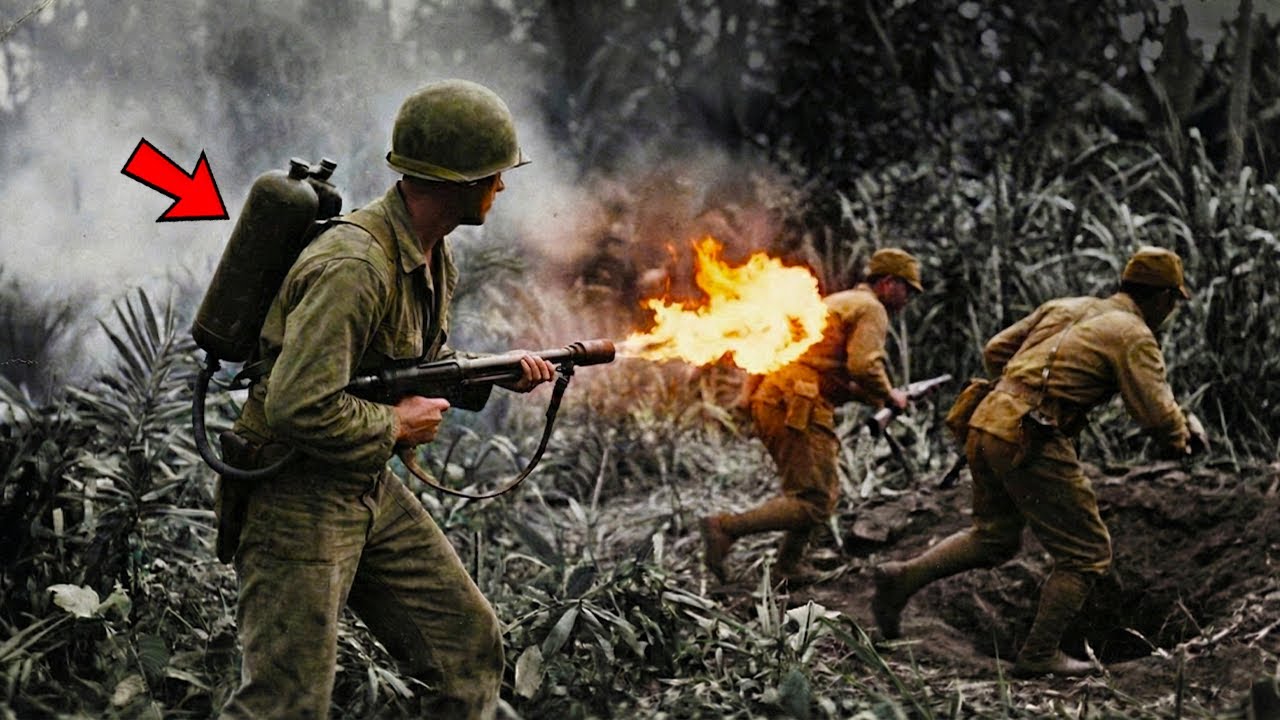
Your fortress becomes your tomb. Afteraction reports show positions that held for hours would fall within minutes once flamethrower teams arrived. The psychological impact was devastating. Nobody was forced to be a flamethrower operator. This was always volunteer. Despite everything, there was never a shortage of volunteers.
Some men wanted to make a direct impact. Flamethrower operators saved lives. Others volunteered because someone had to do it. When your company is pinned down and bleeding, these were men who stepped up. Training was intensive. They learned to operate the weapon, move with it, work with their team, approach fortified positions, and survive.
They trained with live fire, learning to judge distances, manage fuel, move between cover. They also learned their life expectancy. Flamethrower operators in the Pacific had an average combat life measured in minutes. These men knew the statistics. They volunteered anyway. A flamethrower operator never went in alone. That would be suicide.
These teams operated with careful coordination and extensive protection. The typical assault team included the flamethrower operator, an assistant carrying extra fuel tanks, and a rifle squad or fire team providing security. Often they’d have a bar man, a soldier with a Browning automatic rifle specifically assigned to protect the flamethrower operator and suppress any threats.
Sometimes they’d work with demolition teams carrying satchel charges or Bangalore torpedoes. The combined arms approach, fire and explosives working together was devastatingly effective. The tactics followed certain principles. First, you never expose the flamethrower operator unnecessarily. He moved from cover to cover, protected by his team, until he was in range of the target.
Given the weapon’s 30 to 40yard range, this often meant getting dangerously close to enemy positions. Second, you maximized surprise when possible. Teams would approach from unexpected angles, using terrain to mask their movement. The goal was to get close enough that the enemy couldn’t effectively respond before the flame did its work.
Third, once you committed, you were aggressive. There was no halfway with a flamethrower. You pressed the attack hard and fast, giving the enemy no time to react, no opportunity to target you before you’d accomplished your mission. The Japanese learned quickly to watch for these teams. Flamethrower operators with their distinctive backpack tanks became priority targets.
Japanese defenders would concentrate fire on anyone they identified as carrying a flamethrower. They knew that if they could take out the flame before it got in range, they had a chance. This made the job even more dangerous. You weren’t just another marine or soldier. You were marked for death the moment the enemy spotted you.
The flamethrower proved its worth again and again across the Pacific. On Euoima, the flamethrower was absolutely critical. The Japanese had turned the entire island into a fortress with miles of tunnels connecting hundreds of bunkers and pillboxes. Conventional weapons barely scratched these positions, but flamethrower teams working methodically with demolition engineers cleared them one by one.
A marine flamethrower operator on Ewima would advance under covering fire from his squad, get within range of a bunker’s opening, and send a burst of flame inside. The effect was immediate. Either the defenders would be killed by the flame and heat, or they’d attempt to flee through back exits where waiting marines would cut them down.
It was brutal, deadly work. The volcanic ash and rock on Euoima provided little cover. Approaching a bunker meant exposing yourself to fire from multiple positions. Many flamethrower operators were killed or wounded before they could get their weapon in range. But those who made it saved countless lives and kept the assault moving forward.
On Okinawa, flamethrower teams faced an even more challenging environment. The Japanese had dug extensive cave systems into the limestone hills. Some caves went hundreds of feet deep with multiple chambers and exits. Regular weapons couldn’t reach the defenders deep inside. Private first class Richard Clon, a flamethrower operator with the 32nd Infantry Division, exemplified the courage of these men. on lady.
His unit was pinned down by expertly camouflaged Japanese bunkers. Conventional weapons weren’t making a dent. Clon volunteered to take his flamethrower forward. Under heavy fire, he low crawled through mud and jungle for 20 yards to get within range. Bullets cracked past his head. When he finally got close enough, he stood up, aimed, and sent a stream of fire through the bunker’s firing slit.
He cleared three bunkers that day before running out of fuel. His actions broke the stalemate and allowed his company to advance. He received the Bronze Star for his valor. Stories like his could be repeated thousands of times across the Pacific. Casualty rates among flamethrower operators were extraordinarily high.
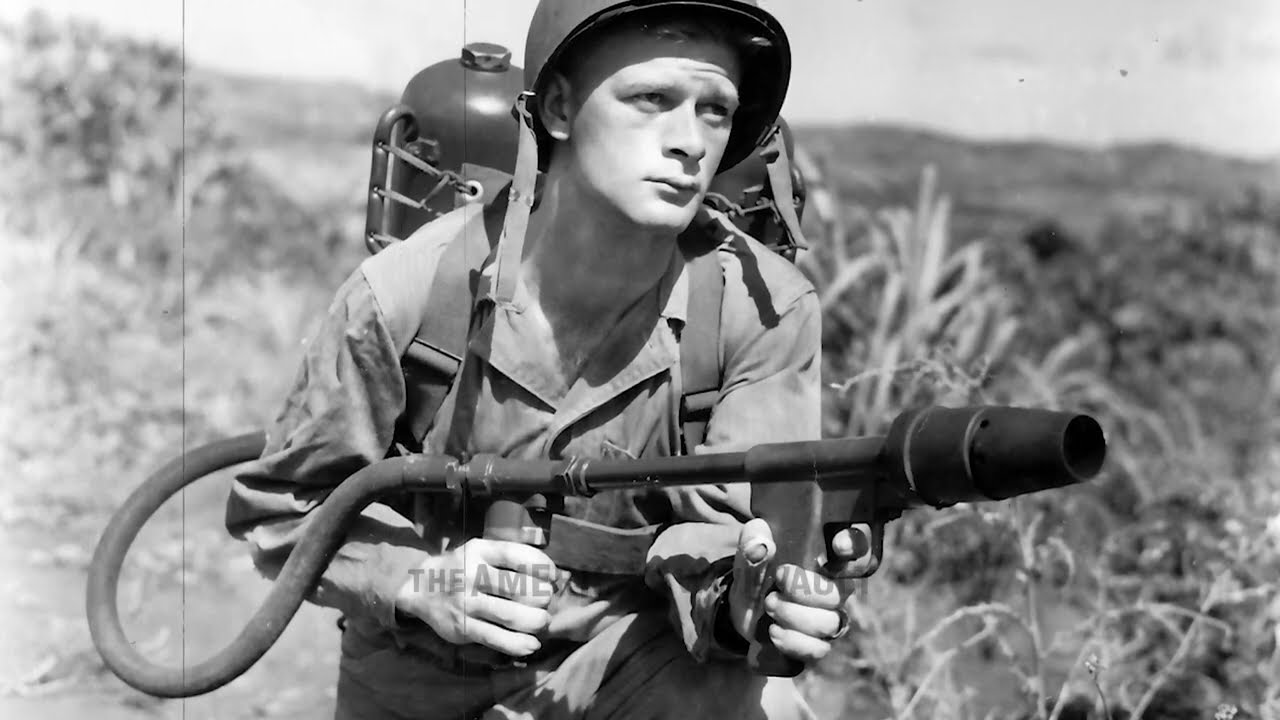
Most didn’t survive many assaults. Those who survived often carried deep psychological scars. They had used fire as a weapon at very close range. They had heard the screams, smelled the burning, seen the effects, no matter how necessary, that took a toll. Many flamethrower veterans didn’t talk about their service after the war.
The weapon, while effective and necessary, was considered particularly horrible. Some felt judged. Others simply didn’t want to revisit those memories. But we need to be clear. These men did necessary, vital work. They saved countless American lives. Every Marine who didn’t have to charge a bunker because the flame team cleared it knew what he owed those men.
The flamethrower was eventually phased out, replaced by other weapons and tactics. But we shouldn’t let modern sensibilities cloud our understanding. In the Pacific War, American forces faced an enemy that had to be completely defeated. The Japanese had built fortifications designed to kill as many Americans as possible.
When conventional weapons couldn’t reduce those positions without prohibitive casualties, flamethrower teams provided the answer. The men who volunteered weren’t sadists or monsters. They were doing an extraordinarily difficult, dangerous job. They were protecting their brothers. They were ending battles quickly that might otherwise have dragged on with mounting casualties.
The fear that Japanese troops felt when facing American flamethrower teams saved American lives. It convinced some defenders to surrender. It shortened battles and brought the war to a quicker conclusion. Japanese troops feared American flamethrower teams because they represented the answer to every defensive advantage Japan possessed.
No matter how deep your cave, how thick your bunker walls, the flame could reach you. Behind every stream of fire was a young American carrying 70 lb of jellied gasoline into the most dangerous situation imaginable. These men didn’t ask for glory. Most didn’t survive the war to receive much. They just did their job and in doing so saved their buddies and brought the war to a faster conclusion.
Remember the flamethrower operators. Remember the men who volunteered to carry fire on their backs into battle. Remember the courage it took to do that job. assault after assault, knowing the odds were against you, but doing it anyway because your country and your fellow Marines and soldiers needed you. That’s the kind of men who won the Pacific War.
That’s the kind of sacrifice that preserved freedom, and that’s why we keep these stories alive in the American World War II vault. Thank you for watching. If you know a World War II veteran, especially one who served in the Pacific, take a moment to thank them. These stories are your legacy. Until next time, stay strong, stay curious, and never forget.
News
“I Could Not Stand”, German Woman POW Weeps When Americans Lift Her Instead
The ground is cold and uneven. Mud clings to boots and hems. Smoke hangs low and smells of burned oil…
“I Expected Screaming”, German Woman POW Stunned by the Silence of American Camps
The train slows in the gray dawn. Frost clings to the wooden planks of the cattle car. The door slides…
“Get These Clowns Out of My Camp”—Why US Command Mocked the SAS Death-Smell Until They BURIED the VC
Get these clowns out of my camp. That is the exact phrase an American colonel used to describe Australian SAS…
Wounded in Vietnam during TET 1968| Don Kaiser’s Story of War, Brotherhood, and Survival.
firing had gotten so intense it was just breaking rice straws off in front of front of our faces. You…
“We Were Starving”, German Women POWs Shocked by American Soup Pots
Late April 1945, a thin mist hangs over a shattered German town. Broken roofs drip from the night rain. A…
The Darkest Secret of Nazi Germany: The Breeding Program That Even Hitler Feared
You remember those old grainy documentaries, the ones that detail the darkest corners of the Third Reich? We often talk…
End of content
No more pages to load