In the pantheon of NBA legends, Shaquille O’Neal is usually the one telling the jokes, the one boasting about his dominance, the one reminding everyone that he is the “Most Dominant Ever.” But in a rare moment of vulnerability and candor, the Big Diesel dropped a bombshell that changes how we look at his trophy case. While the world reveres his three-peat with the Los Angeles Lakers as the peak of his powers, Shaq just revealed that his favorite championship wasn’t won in purple and gold.
It was won in Miami. And the reason why is a cocktail of insecurity, “misfit” chaos, and a burning obsession with one specific rival: Kobe Bryant.
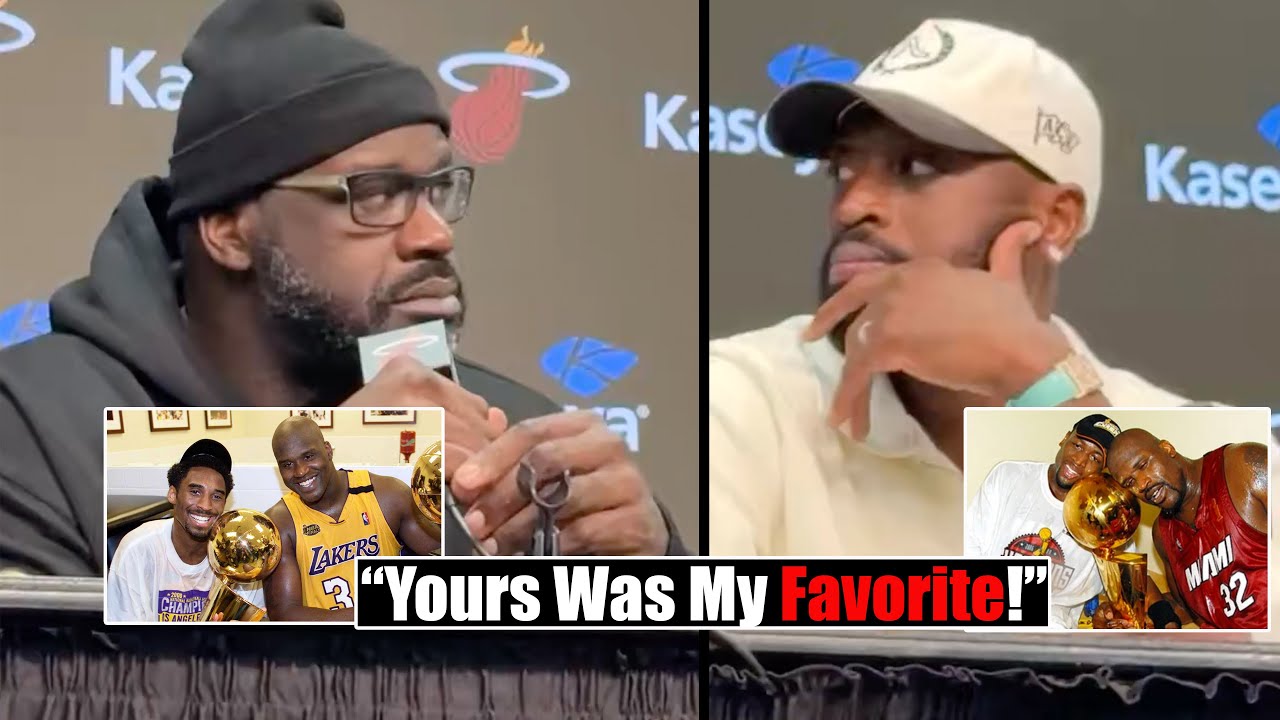
The “Other Guy” Factor
For two decades, the Shaq-Kobe feud was the soap opera that powered the NBA. Even after they parted ways, the cold war continued. In a recent sit-down, Shaq stripped away the media training and admitted exactly what was driving him during that 2006 run with the Miami Heat. It wasn’t just about bringing a title to South Beach; it was about the scoreboard in his personal war with Kobe.
“I needed to get number four before the other guy got his fourth,” Shaq confessed, refusing to even say Bryant’s name. “I was pressured to win.”
At the time, Shaq had three rings. Kobe had three. The race to number four was, in Shaq’s mind, the tiebreaker that would define their divorce. This admission adds a layer of frantic desperation to the 2006 Finals that few understood at the time. Shaq wasn’t just playing for a ring; he was playing for the ultimate bragging rights.
The Reality Check: “You Ain’t Shaq No More”
But the path to that fourth ring required Shaq to do something he had never done before: swallow his ego.
The Heat found themselves in a 0-2 hole against Dirk Nowitzki’s Dallas Mavericks in the NBA Finals. Shaq was struggling. The dominance that had terrorized the league for 15 years was fading. Enter Gary Payton, the legendary trash-talker and teammate who refused to let the ship sink.
Shaq recounted the moment Payton busted into his hotel room after Game 2, delivering a message that would have gotten anyone else punched in the face.
“Gary busted in my room and said, ‘You ain’t the Shaq no more! We need to get D-Wade the ball!’” O’Neal recalled.
The old Shaq might have fought back. The old Shaq would have demanded the post-ups. But this version of Shaq, desperate for that fourth ring, listened. He realized the torch had to be passed. “I was struggling,” Shaq admitted. “I said, ‘No, just let me get Game 3.’ He said, ‘F*** that! We got to get Dwayne the ball.’”
That conversation shifted the tectonic plates of the series. Shaq stepped back, Dwyane Wade stepped up with a “Jordanesque” performance, and the Heat rattled off four straight wins. It was the moment Shaq transitioned from Superman to the ultimate sidekick, a sacrifice that secured his legacy.
A Team of Misfits and “40 Fights”

Beyond the personal rivalries, Shaq’s love for the 2006 title stems from the chaotic nature of the team itself. He described that Heat roster not as a well-oiled machine, but as a dysfunctional family of “misfits.”
“We would have damn near fist fights in the locker room, on the bus,” Shaq laughed. “We probably had about 40 fights.”
From Gary Payton to Antoine Walker to Jason Williams, the locker room was a powder keg of strong personalities. Yet, Shaq insists that this volatility was their superpower. They would scream at each other until they were hoarse, then go out to dinner like brothers. It was a stark contrast to other teams he had been on, where silent resentment would fester for months. This team aired their dirty laundry, fought it out, and then went to war together.
Wade’s “Gold Standard”
For Dwyane Wade, the 2006 championship holds a different, but equally heavy weight. As he sat beside Shaq, Wade explained that prior to 2006, he had never won a championship at any level—not in high school, not in AAU, and not in college. He was always the guy who got close but couldn’t close the deal.
“It was the first time in my life that I showed myself that I can actually lead a team,” Wade said.
That title didn’t just validate Wade as a superstar; it birthed “Heat Culture.” It took a franchise that was often an afterthought and turned it into a destination for winners. As Shaq noted, without that 2006 banner, the “Big 3” era with LeBron James likely never happens. That first ring set the standard.
Legacy Reframed

Shaq’s admission offers a fascinating glimpse into the mind of a superstar. We often assume that an athlete’s “peak” years hold the fondest memories. But for O’Neal, the struggle of 2006—the pressure of the Kobe rivalry, the acceptance of his own aging game, and the bond with a chaotic group of veterans—tastes sweeter than the easy sweeps of the Lakers era.
He didn’t win that ring with brute force; he won it with humility. He didn’t win it to silence the critics; he won it to silence “the other guy.” And in doing so, he proved that sometimes, the most important strength a superstar can have is knowing when to let someone else take the final shot.
News
How a Black Female Sniper’s “Silent Shot” Made Germany’s Deadliest Machine Gun Nest Vanish in France
Chicago, winter 1933. The Great Depression had settled over the Southside like a fog that wouldn’t lift. The Carter family…
Polish Chemist Who Poisoned 12,000 Nazis With Soup — And Made Hitler Rewrite German Military Law
The German doctors at Stalag Vic never suspected the mute Polish woman who scrubbed their floors. November 8th, 1944. Hemer,…
This Canadian Fisherman Turned Sniper Killed 547 German Soldiers — And None Ever Saw Him
November 10th, 1918. 3:37 in the morning, a shell crater in Belgium, 40 yards from the German line. Silus Winterhawk…
They Called Him a Coward for Refusing to Fire — Then His ‘Wasted’ 6 Hours Saved 1,200 Lives
At 11:43 a.m. on June 6th, 1944, Private Firstclass Daniel McKenzie lay motionless in the bell tower of St. Mirly’s…
Steve Harvey Stopped Family Feud After Seeing This
The studio lights were blazing. 300 people sat in the audience, their faces bright with anticipation. The Johnson family stood…
He Was a Hungry Teen — Until One Woman Changed His LifeForever
Steve Harvey stands frozen. The Q cards slip from his fingers and scatter across the studio floor. 300 audience members…
End of content
No more pages to load