The harshest nicknames in the Red Army were not given to the enemy, but to their own equipment. bald Ferdinand, and cruise mass grave. These were the names given to the vehicle that would become the second most common armored vehicle in the USSR after the legendary T34. 14,000 self-propelled guns rolled off the assembly lines of three factories, and almost every crew came up with some kind of unprintable nickname for them.
Inside this vehicle, there was a special atmosphere unlike any other. The driver mechanic sat in the front of the hull, squeezed between the fuel tanks and the hot engine, and even in 30° frost, he was drenched in sweat. 3 meters away from him in the open rear cabin, the commander, gunner, and loader were freezing in the wind, trying to warm their fingers with their breath so as not to lose sensitivity when aiming the gun.
During street fighting, grenades flew into this cabin from above. And yet it was this cheap, light, cursed machine that passed through the Bellarusian swamps where heavy tanks sank, survived the Corsk bulge, and reached Berlin in the front ranks of the assault. But to understand how an engineering failure turned into a weapon of victory, we need to go back to the fall of 1941 when the Red Army realized that its artillery was fighting with methods from the previous century.
In the summer and fall of 1941, Soviet artillery was dying on the roads of retreat. The F-22 and USV Divisional guns weighed 1.5 tons each and were moved by horse or motorized transport, which in the conditions of maneuver warfare meant certain doom. It took up to 20 minutes for a crew of six to unhitch the gun from the cart, turn the carriage, drive the skids into the ground, and aim the barrel at the target.
German tanks needed three times less time to cover a kilometer. The shell would catch up with the artillery men before they had time to fire their first shot. Changing firing positions under fire was suicidal. Crews were killed at the gun carriages before they had time to unhitch the gun from the wrecked tractor, or they would abandon their guns in the mud and retreat with only their carbines.
By the winter of the first year of the war, the Red Army had lost over 30,000 guns, and a significant part of these losses were accounted for by divisional artillery, which was unable to keep up with the pace of the catastrophe. The Germans had learned this lesson long before 1941. Their 2G3 assault guns accompanied the infantry closely, never falling more than a kilometer behind and could open fire seconds after stopping.
Lows slung, inconspicuous, with 70 mm of frontal armor. They appeared where Soviet artillerymen were still looking for a position to deploy. The Red Army had nothing like this. Before the war, self-propelled artillery was considered a secondary, almost exotic field. And now, those who found themselves at the forefront of the German tank wedges were paying for this neglect with their blood.
The infantry desperately needed their own armored vehicles with guns, a machine capable of marching alongside soldiers, firing directly at pillboxes and machine gun nests, and changing position in minutes rather than half an hour. The question was where to get it amid the chaos of evacuation and industrial catastrophe. The first solutions were born out of desperation and looked accordingly.
A ZIS-30 anti-tank gun, which weighed almost as much as the entire vehicle, was mounted on the chassis of a Kamsa’s light artillery tractor, weighing 3 1/2 tons. When fired, the barrel recoiled with such force that the tractor jumped half a meter and the crew was thrown against the metal. The site was hopelessly knocked out of alignment.
The mechanic was deafened by the noise and after a dozen shots, the gunner could no longer hit a tank from 500 m. In besieged Lenenrad, workers at the Kiraov plant cut off the turrets of damaged T26 tanks, placed regimental guns in their place, and obtained at least some kind of self-propelled support vehicle.
The crew remained exposed on all sides. But even such a makeshift solution seemed better than a horsedrawn gun. Design bureaus offered their own versions and almost all of them came to nothing. The OSA76 project with a Gorki automobile engine failed the tests. Plant number 37 in Severlossk built a prototype of a light self-propelled vehicle, but the machine proved too crude for series production.
Everything came down to the same thing. The industry evacuated beyond the eurals was just starting production at new sites. At tankrad in Chelabinsk, machines were assembled in unfinished workshops in the open air and workers alternated shifts on the conveyor belt with shifts at the construction site for the factory walls.
There was a shortage of skilled personnel. Every gram of armor went into the endless furnace of war, and creating a fundamentally new combat vehicle from scratch meant spending years that the front did not allow. In October 1942, the state defense committee issued a decree on the production of self-propelled assault vehicles, but the conditions were strict.
Only proven components could be used. No new chassis, no experimental guns. Assemble from what was already coming off the assembly line. The task seemed impossible. But at factory number 38 in Kiraov, there was a man who thought otherwise. By the fall of 1942, Seamun Alexandrovich Ginsburg knew Soviet armored vehicles better than anyone else.
He had worked on light tanks, supervised the development of chassis, power units, and transmissions. And when the question of self-propelled guns arose, Ginsburgg saw a solution where others saw a dead end. The idea was elegant in its simplicity. Take the chassis of the T70 light tank, already in serial production at several factories.
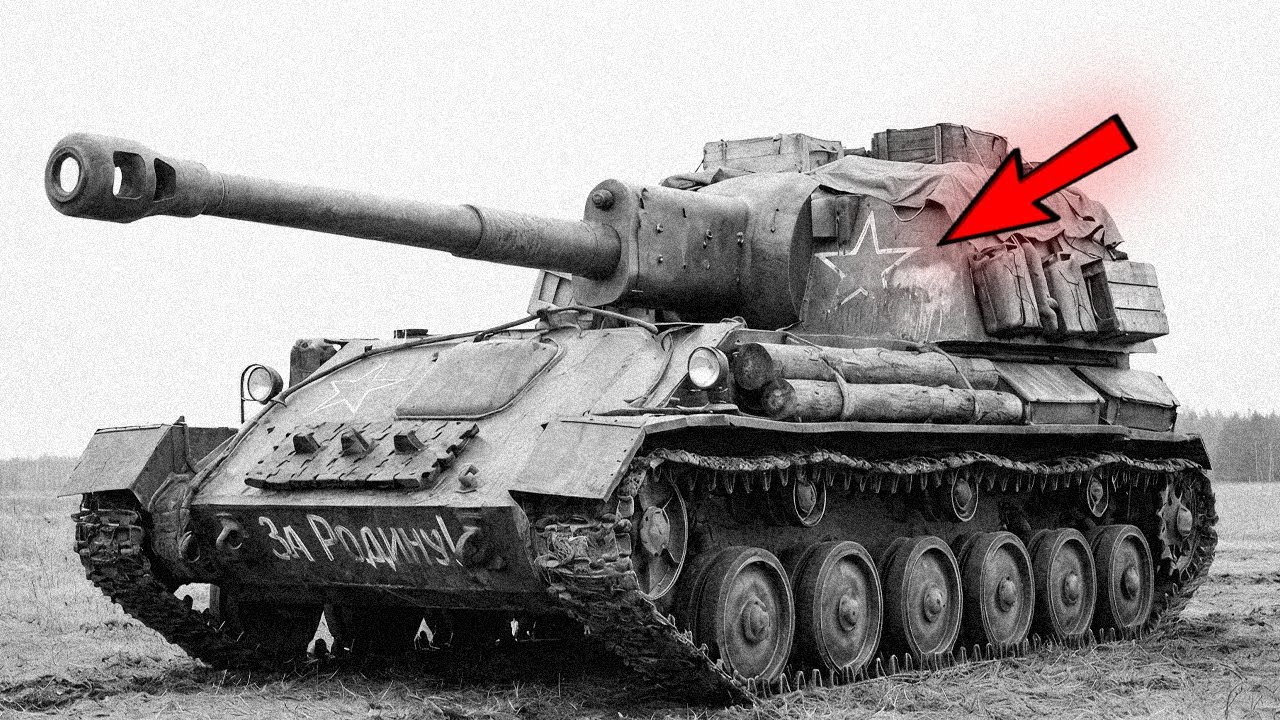
Extend the hull by one pair of road wheels to accommodate the fighting compartment. At the rear, we install Vasili Grabinsk’s ZIS-3 gun, the most technologically advanced and mass-produced weapon of the war, which artillerymen knew by heart and could repair in the field using materials at hand. Everything needed for production is already coming off the assembly lines.
No new machines, no worker retraining. Grabbin’s cannon was an engineering marvel in its own right. The world’s first mass-roduced artillery weapon, the ZIS3, cost three times less than its predecessor and could be manufactured by lowskilled workers using substitute materials. Stalin himself, seeing it at a demonstration, called the gun a masterpiece of artillery design.
A wide range of ammunition enabled it to hit infantry with fragmentation shells, tanks with armor-piercing shells, and from 1943, subcaliber shells that could penetrate 100 mm of armor at half a kilometer. There was no better weapon for a light self-propelled gun. In December 1942, Ginsburgg’s vehicle designated factory index SU12 passed government tests.
The commission noted some shortcomings, but time was running out. And on the second of that month, by decree of the State Defense Committee, the self-propelled gun was accepted into service under the designation SU76. Serial production began in January, and the first vehicles were sent to the front without waiting for the shortcomings to be eliminated.
It seemed that the answer to the infantry’s prayers had finally been found. No one yet knew what kind of time bomb had been planted in the design by the engineers haste. In January 1943, the first two SU76 self-propelled artillery regiments went to the Fulkhoff front where Ginsburgg’s vehicles encountered a reality that no factory tests could have foreseen.
The swampy forest south of Lennengrad required the engine and transmission to operate in second gear almost constantly, and it was in this mode that the fatal miscalculation became apparent. The SU76’s power plant consisted of two GAZ 200 twocar engines, each with a capacity of 70 horsepower installed in parallel.
Each motor drove its own track through a separate gearbox and synchronizing their operation was extremely difficult even for an experienced mechanic. However, the main problem lay deeper. At certain speeds, the engines would resonate and torsional vibrations would travel along the shafts in a growing wave until they inevitably sheared off the teeth of the gears.
The self-propelled guns came to a standstill, one after another, in the middle of the muddy clearings, turning from weapons into a burden for the very infantry they were supposed to support. Of the 560 vehicles produced, only a few remain combat ready, and it was impossible to hide a failure of this magnitude from the state defense committee.
The investigation quickly and ruthlessly identified those responsible. Isaac Salsman, the people’s commisar for tank industry, was removed from office in June. However, the real price was paid by Seaman Ginsburg, the designer who tried to give the army what it demanded within impossible deadlines. He was removed from his job and sent to the front as a rank and file engineer in the 32nd Tank Brigade, as if in mockery, returning him to the vehicles he had created.
On August 3rd, 1943 near the village of Malaya to Marova on the Corsk Bulge, Ginsburgg died in battle, never seeing his brainchild reborn as the Red Army’s most mass-produced self-propelled gun. While the investigation sought to find those responsible, engineers Nikolai Astro and Andre Lipgart of the Gori Automobile Plant sought a solution.
They rearranged the engines in series, connecting them to a common shaft as was done on the T70 tank, and the resonance problem disappeared. However, another problem remained in the closed combat compartment of the first SU76s. After 15 shots, the concentration of powder gases exceeded the permissible norm, and the crew began to lose consciousness from carbon monoxide poisoning.
Firing was only possible with the rear hatch open, which made the crew vulnerable. The solution seemed radical and at first glance absurd. The roof of the fighting compartment was removed altogether. In the summer of 1943, the modernized SU76M with an open rear cabin rolled off the assembly line, and it was in this form that the vehicle finally gained reliability.
The curse became a feature and over time it would become both a curse and a salvation. In the summer of 1944, the Red Army was preparing an operation that would go down in history under the code name Bagraton. The goal was to liberate Bellarus. But between the Soviet troops and Minsk lay the Pinsk marshes and the endless swamps of Polazi.
The German command considered this area impassible for large armored formations and kept relatively weak forces here, concentrating its reserves on more tank dangerous directions. The calculation seemed reasonable. Heavy tanks got stuck in the swamp up to their turrets. However, the SU76M weighed only 10.5 tons.
Its specific ground pressure was just over half a kilogram per square centimeter, less than that of a fully equipped soldier. Where the T34s got stuck, the light self-propelled guns passed through Pete bogs, hastily constructed roads and bridges that could not withstand anything heavier than a loaded cart. On June 23rd, the offensive began, and the Soviet troops struck the Germans from where they least expected it.
The Su76M moved alongside the infantry through the swampy forests, suppressing firing points with direct fire and destroying machine gun nests and dugouts near Babusk. Several German divisions were surrounded, and by the end of June, the pocket was eliminated. Army Group Center, which had stood as an impenetrable wall for three years, ceased to exist as an organized force.
In these battles, the SU76M found its true calling. Not a tank destroyer, not an assault gun, but what it was designed for from the very beginning. A faithful companion to the infantry, capable of going where soldiers could go. The lightness that crews cursed for its weak armor turned out to be a strategic advantage.
The low cost for which the vehicle was despised by tankers and heavy is tanks enabled saturation of troops with self-propelled artillery in a way never achieved before or since. By the end of 1944, the SU76M accounted for a quarter of all Soviet tracked combat vehicle production. In the spring of 1945, the war came to the streets of German cities and a completely different battle began for the SU76M.
The narrow alleys of Breastlau, Kunixburg, and Berlin had nothing in common with the Bellarusian swamps. Here, every window could hide a grenade launcher with a fa patron. Every basement was turned into a firing point, and barricades made of trams and cobblestones blocked the streets every hundred meters.
The open cockpit, which provided protection from gunpowder fumes, became a deadly vulnerability. Hand grenades flew from above, and a single well- aimed throw could wipe out an entire crew. Fragmentation shells incapable of penetrating even the thin armor of the hull exploded above the crew’s heads and maimed people with the shockwave.
German snipers targeted commanders who carelessly leaned out from behind the gun shield. The losses among self-propelled guns in street fighting were terrible and the nickname brotherly grave took on a literal meaning for the crew. However, the same openness that killed sometimes saved lives. When a FA patron hit a closed vehicle, the shock wave rushed inside, concussing or killing the crew, even without penetrating the armor.
In the SU76M, the wave went upward, and there was a chance to survive. It was possible to jump out of a burning open cabin in seconds, whereas people did not have time to get out of a closed combat compartment. The casualty statistics were brutal, but they also showed that the percentage of surviving crews in damaged SU76M was higher than enclosed vehicles of the same class.
And there was something else that couldn’t be measured in numbers. The infantry men who stormed Berlin loved the small self-propelled gun precisely because of its open cab. They could shout to the commander, point out the target with their hand, and coordinate the attack without a radio, which wouldn’t work anyway in the den of battle.
In a city where communication between armor and infantry meant the difference between life and death, this ability was invaluable. The crews cursed their vehicle for what the infantry loved it for. And this contradiction was the essence of the SU76. After the victory, the Su76M was not scrapped. The vehicle remained in service with the Soviet army until the early 1950s, and the last self-propelled guns were used as training vehicles for T34 crews until 1955.
The simplicity of its design, once dictated by necessity, now made it an ideal training aid. Hundreds of vehicles were exported. In the Korean War, North Korean SU76M went into battle against American Shermans and Patton, repeating the path taken by their predecessors 10 years earlier.
China, Yugoslavia, Poland, and Albania received self-propelled guns as military aid, and some of them remained in storage until the 1970s. The SU76M was the basis for the first Soviet mass-roduced self-propelled anti-aircraft gun, the ZSU37, and its production continued even after the base vehicle was taken off the assembly line.
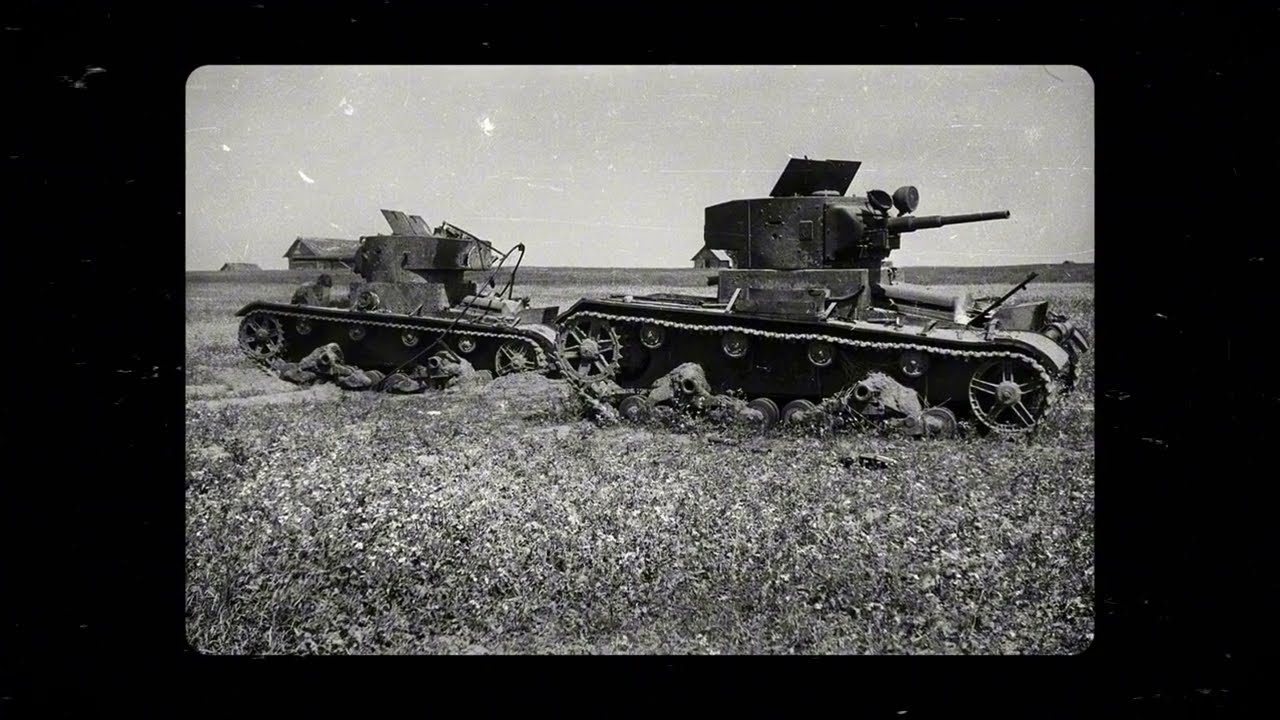
Today, the surviving SU76M are on display in museums and on pedestals from Moscow to Vladivastto. The Museum of Domestic Military History in Pakovo near Moscow has a machine from 1945 with a restored original power plant that is still in working order. In the Ukrainian city of Sarnney, there is an SU76 on a pedestal raised from the bottom of the Sluck River where it fell with its crew in February 1944.
Three tankers remained inside. The Third Reich believed in perfection. Crup and Henchel engineers created machines that were supposed to inspire terror with their appearance alone. Impenetrable armor, monstrous guns, names of predators. Tiger, Panther, King Tiger. Each tank was a work of art, each costing tens of ordinary cars.
Germany built legends. The Soviet Union built tools. The SU76 never pretended to be something it wasn’t. Its thin armor didn’t protect it from shells, and the crews knew it. The open cockpit didn’t protect them from shrapnel, and the crews remembered that. The driver mechanic roasted between the fuel tanks while the gunner froze in the wind 20 cm behind him, and no one pretended that this was intentional.
This machine was honest in its imperfection and perhaps that is why those who fought in it ultimately accepted it for what it was. Simeon Ginsburgg died in August 1943, never knowing that his brainchild would become the Red Army’s most mass-roduced self-propelled gun. He did not design the vehicle for parades or news reels.
He thought about the factories that would have to produce it by the thousands, about the mechanics who would repair it in the field. He thought about the infantrymen who needed a tracked gun here and now, not a promise of a miracle in 6 months. The war proved him right, but he never saw it. 14,280 vehicles, simple enough to build faster than the enemy could destroy them.
Light enough to go where heavy tanks got stuck. Cheap enough to be enough for every infantry course from the Baltic to the Black Sea. Soldiers called it Suko and Colombina. Cursed and thanked it, hated and mourned it. Such relationships only happen with things that are truly important. War is not won by the best weapons.
War is won by sufficient weapons in the hands of those who are prepared to die for them. On the small vicious they reached Berlin.
News
Admiral Shibazaki Boasted “It Will Take 100 Years to Capture Tarawa” — US Marines Did It In 76 Hours
At 13:30 hours on November 23rd, 1943, Colonel David Shupe stood on a two-mile strip of coral called Betio,…
Japanese Troops Were Terrified When U.S. Marines Cleared Trenches Without Letting Go Of The Trigger
On the morning of August 17th, 1942, at 0917, Sergeant Clyde Thomasson crouched behind a palm tree on Makan Island,…
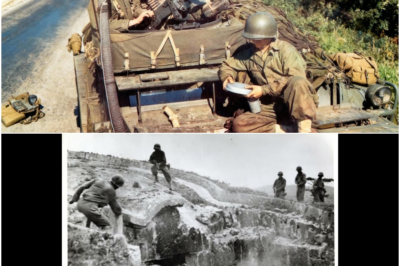
Japanese Soldiers Were Terrified When .50 Caliber Machine Guns Penetrated Their Concrete Bunkers
On the morning of May 14th, 1945, at 0630 hours, Corporal Lewis Ha crouched behind a coral outcrop on Okinawa’s…
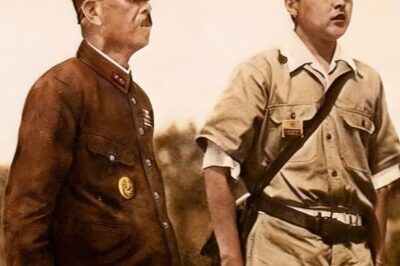
General Hyakutake Ignored The “No Supplies” Warning — And Marched 3,000 Men Into The Jungle To Die
On the morning of December 23rd, 1942, at 0800 hours, Lieutenant General Harukichi Hiakutake sat in his command bunker on…
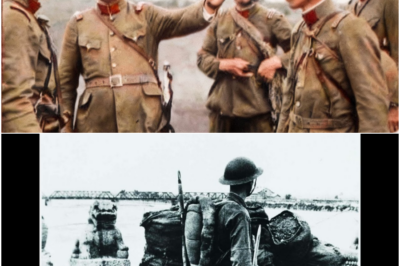
Colonel Ichiki Was Told “Wait For Reinforcements You Fool” — He Attacked Anyway And Lost 800 Men
At 3:07 in the morning on August 21st, 1942, Colonel Kona Ichiki crouched behind a fallen palm tree on the…
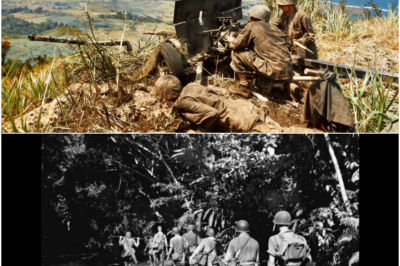
Japanese Soldiers Were Terrified When U.S. Marines Turned Anti-Tank Guns Into Giant Shotguns
On the morning of August 21st, 1942, at 3:07 a.m., Private First Class Frank Pomroy crouched behind a 37 millimeter…
End of content
No more pages to load