
The German Officer Who Found a Jewish Pianist in Hiding… and Chose Mercy
The Nocturne in the Ruins: How a “Good Nazi” Saved Władysław Szpilman and the Tragic Price of Mercy
In the autumn of 1944, Warsaw was no longer a city; it was a charred, skeletal landscape of rubble and ghosts. After the defeat of the Warsaw Uprising, the German high command had ordered the systematic evacuation and destruction of the Polish capital. Among the few living souls left in the ruins was Władysław Szpilman, a celebrated Jewish pianist and composer who had spent years evading the death camps of Treblinka. Starving, jaundiced, and huddled in the attic of an abandoned building at 223 Niepodległości Avenue, Szpilman’s survival seemed like a statistical impossibility.

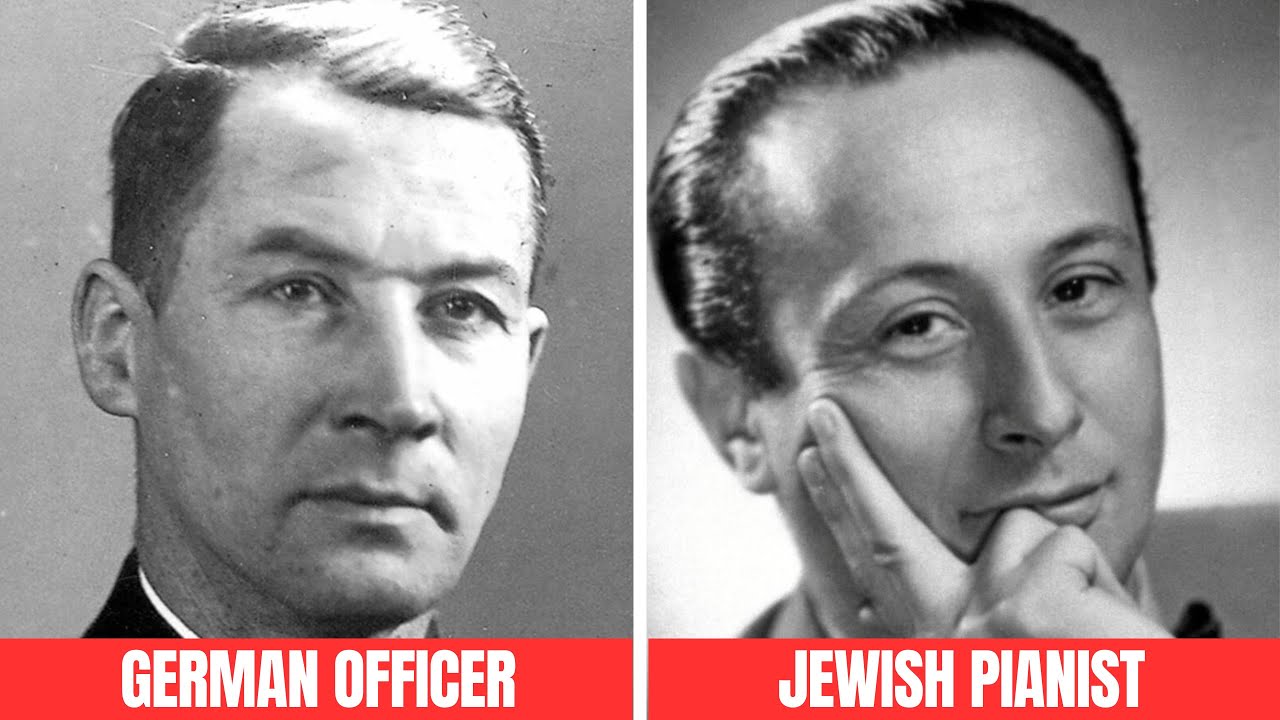
His luck appeared to run out in mid-November when, while searching a kitchen for food, he heard a deep, calm voice behind him: “What are you doing here?” Standing there was Captain Wilm Hosenfeld, a tall German officer whose unit was preparing the building for retreat. What happened next was not an arrest, but a collision of culture and conscience that would become one of the most profound stories of the Holocaust.
The Pianist of Polish Radio
Władysław Szpilman was born in 1911 and became the house pianist for Polish Radio by 1935. He was a specialist in Chopin, a national hero of Polish music. His life changed forever on September 23, 1939, when he was performing Chopin’s Nocturne in C-sharp minor live on the air as German bombs began falling on Warsaw. The broadcast was cut short—a silence that would last for nearly six years.
Confined to the Warsaw Ghetto in 1940, Szpilman watched his entire family—parents, brother, and two sisters—be led to the cattle cars bound for the Treblinka extermination camp in 1942. He was saved only by the intervention of a Jewish policeman who recognized the famous musician and pulled him from the line. For over a year, Szpilman hid on the “Aryan” side of the city, sheltered by Polish friends who risked their lives and their families to keep him alive. After the 1944 Uprising was crushed, he was left entirely alone in a city that was being erased from the map.
The Secret Soul of Captain Hosenfeld
Wilm Hosenfeld was not the typical image of a Nazi officer. Born into a devout Catholic family in 1895, he was a schoolteacher by profession and a veteran of World War I. While he joined the Nazi Party in 1935, believing it would restore German pride, he quickly grew disillusioned by the regime’s systemic cruelty. Stationed in Poland from 1939, Hosenfeld’s official duties involved sports and culture, but his private actions were far more consequential.
In his secret diaries, Hosenfeld recorded the “indelible shame” he felt as he witnessed the liquidation of the Warsaw Ghetto. “With the horrible mass murder of the Jews, we have lost this war,” he wrote. He began using his position to save lives, providing false papers and jobs to fleeing Jews and intervening to save Polish resistance fighters from execution.
The Proof in the Performance

When Hosenfeld confronted the emaciated Szpilman in the ruins, the pianist admitted he was Jewish and hiding. Hosenfeld, skeptical but intrigued, led Szpilman downstairs to a room that contained a piano.
“Prove it,” Hosenfeld commanded.
With hands stiff from the Polish winter and a body weakened by months of starvation, Szpilman sat at the instrument. He began to play the same piece the bombs had interrupted in 1939: Chopin’s Nocturne in C-sharp minor. The music echoed through the hollowed-out building, a fragile thread of civilization in a world defined by barbarity.
Hosenfeld listened in silence. When the piece concluded, the officer made his decision. He did not turn Szpilman in. Instead, he allowed him to hide in the attic, bringing him bread, jam, and eventually his own military coat to survive the sub-zero temperatures. He told Szpilman to “hold on just a little longer,” assuring him that the Soviet army was approaching and the war was nearly over.
The Tragic Aftermath
The two men parted in mid-December 1944 as the Germans evacuated Warsaw. Hosenfeld, embarrassed by his uniform and the actions of his country, refused to give Szpilman his name. Szpilman, however, gave Hosenfeld his: “Remember Szpilman, Polish Radio.”
Warsaw was liberated on January 17, 1945. Szpilman survived, returned to Polish Radio, and famously played the same Chopin Nocturne in his first postwar broadcast. He wrote his memoirs, The Death of a City, in 1946, though Soviet censors changed Hosenfeld’s nationality to Austrian to avoid the “politically incorrect” image of a compassionate German soldier.
While Szpilman found fame, Hosenfeld found a nightmare. He was captured by the Soviets on the day Warsaw was liberated and charged with war crimes due to his role in interrogating prisoners. Despite pleas from Leon Warm (another Jew Hosenfeld had saved) and Szpilman himself, Soviet authorities refused to consider Hosenfeld’s humanitarian record. He was sentenced to 25 years of hard labor. After suffering multiple strokes, Captain Wilm Hosenfeld died of an aortic rupture in a Soviet prison hospital in 1952 at the age of 57.
A Legacy of Honor
For decades, the story remained largely forgotten until Szpilman’s son, Andrzej, published a new edition of the memoir titled The Pianist in 1998, which included Hosenfeld’s diary entries. The book became an international sensation and was adapted into an Academy Award-winning film by Roman Polanski in 2002.
In 2009, Yad Vashem posthumously recognized Wilm Hosenfeld as “Righteous Among the Nations,” a title reserved for non-Jews who risked their lives to save Jews during the Holocaust. Today, a plaque marks the spot where the soldier and the pianist met—a testament to the fact that even in the deepest darkness of total war, the choice to be human remains.
Władysław Szpilman died in 2000 at the age of 88, having spent his final years tirelessly advocating for the recognition of the man who had asked him to “prove” his humanity through his music. Their story remains a powerful reminder that while systems and armies may collapse, individual acts of mercy are immortal.
News
Explosive Hearing: Hawley Pressures Netflix Boss on Gender Ideology and US Workers
Josh Hawley Puts Netflix CEO on the Hot Seat Over Politics and Jobs “Our DNA is American”: Senator Josh Hawley…

Hollywood in Crisis: Americans Turn on Celebrities After Grammys ICE Backlash
Hollywood Loses Support as Fans Boycott Stars Over Grammys Controversy Hollywood’s Great Collapse: Millions Boycott ‘Out-of-Touch’ Elites After Billie Eilish’s…

“Non-Stop Corruption” — Chris Murphy Stuns Lawmakers With Blistering Trump Accusation
Chris Murphy Drops Explosive Claims About Trump’s “Corruption Machine” in Congress “A Non-Stop Corruption Machine”: Senator Chris Murphy Exposes Secret…

After Minneapolis Enforcement Chaos, Law Enforcement Isn’t Buying ICE’s Victim Narrative
Local Police Push Back Hard After ICE Tries to Portray Themselves as Victims In the quiet suburbs of Chicago, a…

“Lawless and Out of Control” — Jasmine Crockett Confronts ICE Over Renée Good Shooting
Explosive Hearing: Jasmine Crockett Slams ICE Tactics After Fatal Minneapolis Shooting “A Lawless Regime”: Congresswoman Jasmine Crockett and Senator Mazie…

“How Can She Sleep?” — Maxine Dexter Slams Kristi Noem Over ICE Conditions
Maxine Dexter Unleashes Scathing Attack on Kristi Noem Over ICE Detention Crisis “This is Fascism”: Congresswoman Maxine Dexter Blasts Secretary…
End of content
No more pages to load