
Vikings Had No Central Heating — So How Did They Survive Winter?
For centuries, the popular image of a Viking village in the dead of winter has been one of desperate, smoke-choked misery. We imagine shivering warriors huddled around dying embers in drafty huts, while the relentless Arctic wind cuts through every crack in the timber. It is a logical image—until you look at the archaeology. Recent excavations across Scandinavia, Iceland, and Greenland tell a much quieter, more unsettling story: Viking homes didn’t just survive the winter; they outperformed many modern energy-efficient houses today.
The secret wasn’t magic, and it wasn’t a heroic surplus of firewood. It was engineering—subtle, cumulative, and systemic. The Vikings didn’t look at winter as an enemy to be conquered with more fire; they looked at it as a condition to be managed. They shifted the fundamental question of architecture from “How do we make more heat?” to “How do we lose less of it?” This singular shift in thinking created a thermal system that utilized everything from the grass roots in the walls to the very breath of the family cow.
The Longhouse as a Living Organism
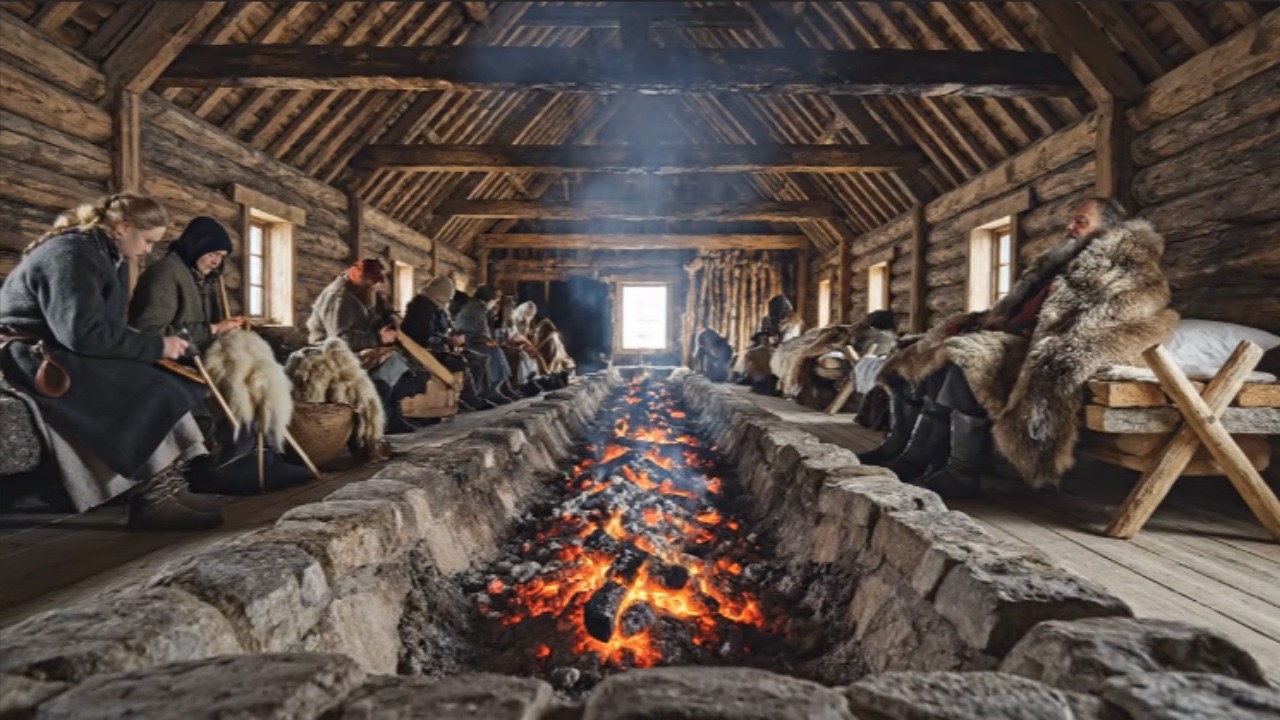
A Viking longhouse was not a “building” in the modern, static sense. It was a 20-to-80-meter-long survival mechanism. Entire communities lived beneath a single roof, and this wasn’t just about social cohesion—it was about physics. Human bodies are constant heat engines. By concentrating dozens of people into one enclosed space, the Vikings transformed population density into a renewable thermal resource.
The very shape of the house reflected this maritime-inspired logic. The walls were gently curved, echoing the halls of the iconic Viking ships. This allowed the brutal sub-zero winds to slide around the structure instead of striking it head-on and stripping away warmth. Like a ship’s crew riding out a storm, everyone inside the longhouse became part of a shared biological furnace.
Turf: The Invisible Thermal Battery
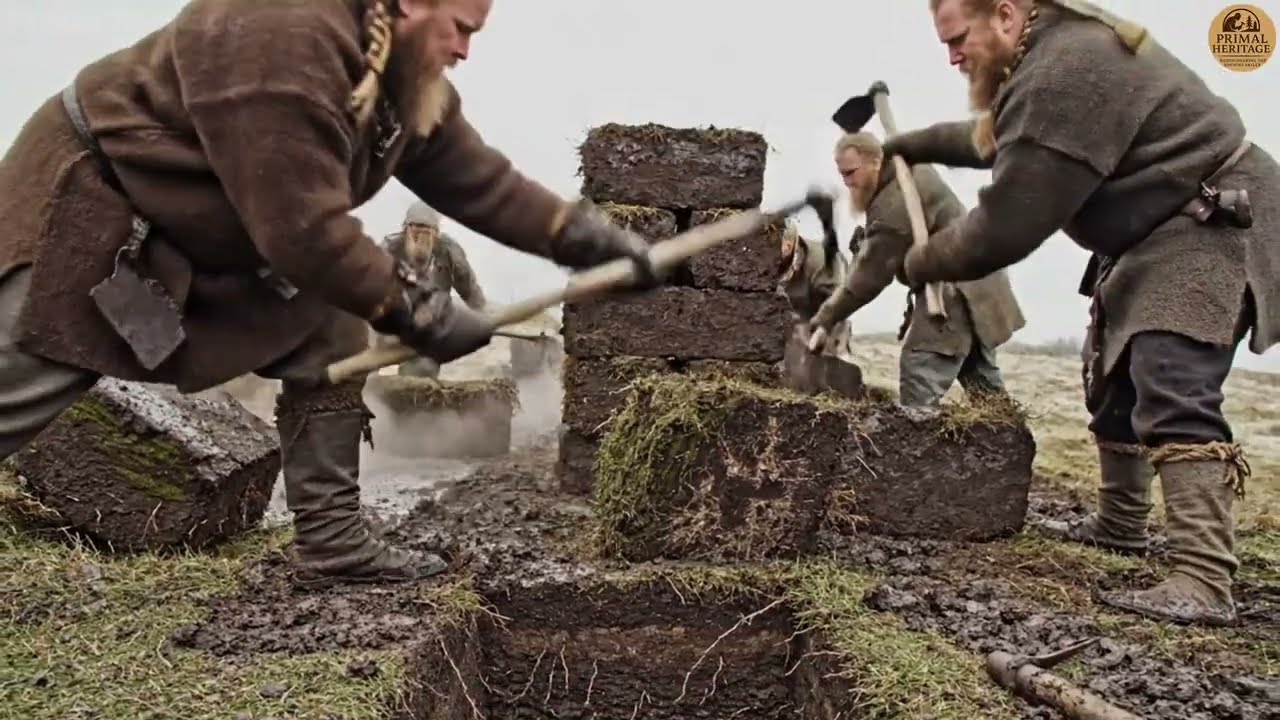
Contrary to the “log cabin” myth, Vikings in treeless regions like Iceland and Greenland built with the earth itself. They cut massive turf blocks directly from the ground—layers of soil woven together by dense grass roots. These walls were stacked up to two meters thick at the base.
The brilliance of turf lies in the physics of “still air.” Soil contains millions of tiny air pockets trapped by roots, and still air is one of the most powerful insulators known to science. These walls became natural thermal batteries, absorbing the heat from the central fire during the day and slowly releasing it into the room at night. Over time, the grass on the walls would regrow, sealing the structure and tightening the air-seal further. The house didn’t just stand on the land; it became a part of it.
Livestock: The precision Energy Management
To modern sensibilities, the idea of sharing a living space with cows, sheep, and goats seems crude. To a Viking engineer, it was a stroke of genius. During the coldest months, livestock were brought into large sections of the longhouse. A single cow produces as much radiant heat as several modern space heaters.
The Vikings even utilized gravity and thermodynamics in the layout. Livestock areas were set slightly lower than human living spaces. As the animals breathed and moved, the warm air naturally rose, flowing into the areas where the family gathered and slept. Heat moved where it was needed without a single pipe or machine—just biology guided by architecture.
Controlling the “Wind-Thief”
The Vikings understood what modern builders often forget: Cold rarely kills on its own, but wind does. Moving air strips heat from a body faster than fire can replace it. Consequently, Viking homes had almost no windows. Even if glass had been common, a window was seen as a hole in the house’s thermal armor.
Entrances were kept low and narrow, forcing visitors to stoop. This wasn’t a sign of humility; it was a physical barrier. A small opening meant less cold air rushing in and less warm air escaping. Many longhouses even featured an unheated “passageway” or vestibule—a primitive airlock that absorbed the shock of the outside air before it could reach the hearth.
The Hearth and the Smoke Blanket
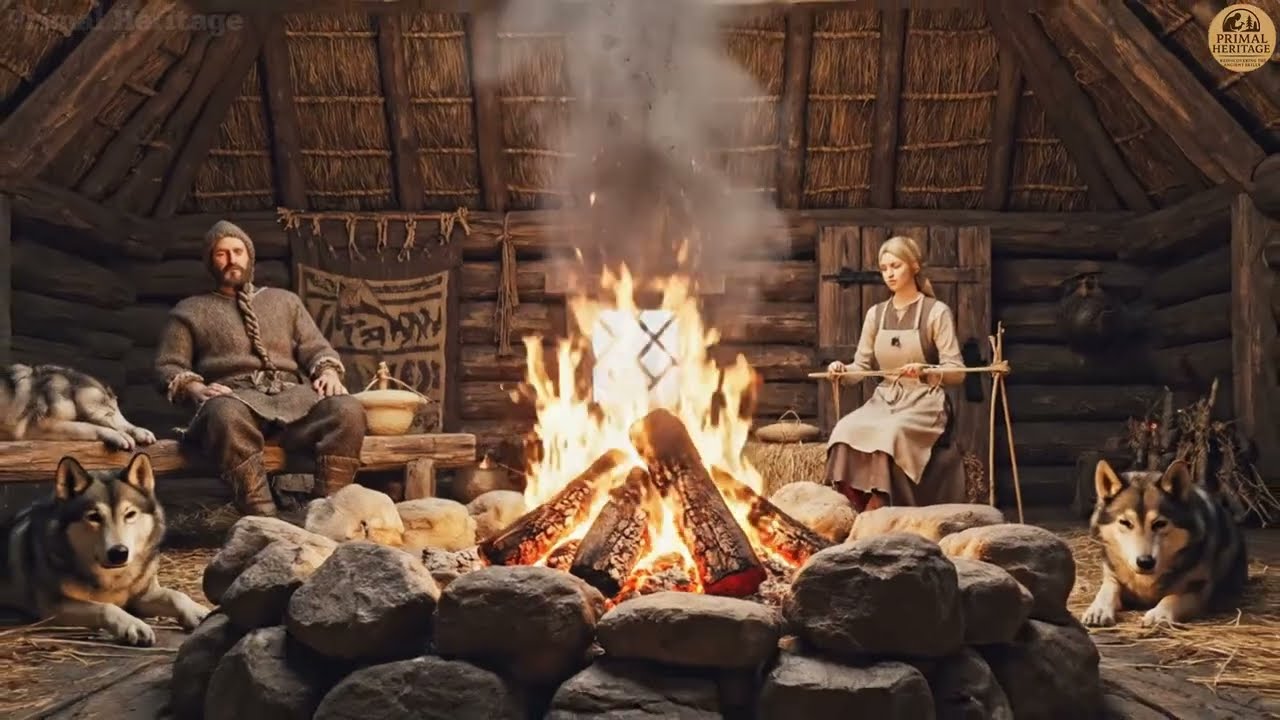
At the center of every longhouse was a 10-meter open hearth. Stone-lined pits beneath the fire absorbed the intense heat and released it slowly over hours, long after the flames had died down. But the most misunderstood feature of the longhouse was the lack of a chimney.
In a Viking home, smoke was not a flaw; it was a component. Smoke rose to the ceiling and gathered there, forming a warm layer that acted as an invisible blanket, trapping the heat below where the people lived. Simultaneously, the soot coated the wooden beams, protecting them from insects, moisture, and rot. The house “breathed” slowly through adjustable roof vents that were kept nearly closed in winter. Air quality was sacrificed for the sake of survival, but the result was a microclimate that remained stable even in the face of an Arctic gale.
Snow as Armor
While modern homeowners rush to shovel snow away, the Vikings allowed it to settle. They understood that snow, which traps air between its crystals, is one of the best natural insulators on Earth. Entire villages would “disappear” beneath deep snowdrifts, leaving only thin columns of smoke visible. Beneath that frozen armor, the temperature against the walls hovered near freezing—dramatically warmer than the -30°F air outside.

Conclusion: The Forgotten Wisdom
Viking villages never froze because they were built on the principle of alignment rather than resistance. They didn’t fight nature; they leveraged it. By integrating earth, biology, fire, and behavior into a single, closed-loop system, they created environments that could sustain life where modern technology would struggle. As we face our own energy crises today, the “earth-ships” of the North leave us with a haunting question: What other ancient, life-saving wisdom have we discarded in our rush for the “modern” way?
News

New Message Sent to Nancy Guthrie’s Alleged Kidnappers — But Are the Ransom Notes Real?
Mystery Deepens: Family Sends New Plea as Ransom Note Claims Face Scrutiny The quiet suburbs of Tucson, Arizona, remain at…

WATCH: Karoline Leavitt Slams Democrats After Deadly Indiana Case
WATCH: Leavitt Sparks Debate After Responding to Indiana Crime Case “Lowest Murder Rate Since 1900”: Karoline Leavitt Slams “Democrat Chaos”…

“You’re Going to Jail” — Sha’Carri Richardson’s 104 MPH Traffic Stop Goes Viral
Olympic Star Sha’Carri Richardson Faces Legal Trouble After High-Speed Stop “Wipe That Smile Off Your Face”: Olympic Gold Medalist Sha’Carri…

DL Hughley Speaks Out on Nicki Minaj’s MAGA Controversy in Blunt New Statement
DL Hughley Breaks Silence on Nicki Minaj’s Politics as Backlash Grows “Embarrassing Last-Second Save”: How Nicki Minaj Scrambled to Pay…

Sen. Gallego Drops Bombshell on Bessent’s Alleged Plan to Funnel $10B to Trump
Sen. Gallego Drops Bombshell on Bessent’s Alleged Plan to Funnel $10B to Trump “The Most Brazen Self-Dealing Scheme in History”:…

ICE Encounter Turns Violent: U.S. Citizen Shares Terrifying Story of Shots Fired at His Family
“I Thought We’d Be Killed” — Martin Rascon Recounts Federal Agents Shooting at His Car “Three Minutes That Changed Our…
End of content
No more pages to load