1942, a batch of early M1 bazookas reaches British commanders in Egypt for evaluation. They arrange a demonstration against a captured Panza 3. The rocket hits, it penetrates, the weapon works, and the British say, “No, thank you.” This was not arrogance. This was not bureaucratic stubbornness. The British had already begun production of something different, something that looked crude, felt brutal, and operated on principles the Americans had rejected.
The Pat weighed nearly twice as much as the bazooka. It required enormous physical strength just to Soldiers cursed it, struggled with it, and in some cases physically could not operate it. But it could do something the bazooka never could. It could fire from inside a building without killing everyone behind the operator. In the hedgero fighting of Normandy, the rubble of Italian towns, and the desperate house-to-house combat at Arnham, that single advantage proved decisive.
According to British army analysis of the initial overlord period, PAT teams destroyed 7% of all German tanks knocked out by British forces. That figure exceeded the kill rate of RAF rocket firing Typhoons. A weapon that looked like a plumber’s nightmare outperformed aircraft.
The problem both weapons tried to solve was simple to state and terrifying to face. German armor had outpaced infantry anti-tank weapons. By 1941, British soldiers confronting Panza 3s and fours had few options. The boy anti-tank rifle firing a.55 caliber round could penetrate 21 mm of armor at 300 yd. German tanks now carried 30 to 50 mm of frontal protection, often sloped.
The boys was obsolete before the war properly began. Anti-tank guns worked, but they weighed thousands of pounds and required vehicles to move. Infantry needed something a single soldier could carry into combat. Something that could kill a tank at ranges where the tank could kill you first. The shaped charge, exploiting what physicists called the Monroe effect, offered a theoretical solution.
A cone of copper backed by explosive could upon detonation collapse into a hypersonic jet. This jet could punch through armor far thicker than any kinetic projectile of equivalent size. The challenge was delivering that shape charge to the target. The Americans chose rockets. The Germans chose rockets. The British chose a spring.
Lieutenant Colonel Laam Valentine Stewart Blacker was not a conventional weapons designer. An Indian Army veteran and early aviation enthusiast, he had spent years tinkering with unconventional ordinance concepts. He patented his spigot mortar design in 1930 and spent a decade trying to interest the military.
The principle was counterintuitive. Instead of launching a projectile from inside a barrel, the spigot mortar used a solid steel rod. The bomb sat over this rod, its hollow tail containing a small propellant charge. When fired, the rod struck the propellant and the resulting explosion launched the bomb forward while simultaneously driving the rod backward.
All the energy went into the projectile. There was no tube to contain expanding gases. There was no back blast. After Dunkirk desperation opened doors, Churchill witnessed a demonstration of Blacker’s first creation, the Black Bombard, a 112lb fixed mount weapon firing 20 lb anti-tank bombs. Over 22,000 were produced for the Home Guard.
But Blacker envisioned something portable. When he demonstrated his shoulder fired version to the War Office in June 1941, everything went wrong. The casing was flimsy. The spigot misfired. Bombs failed to detonate on contact. The Ordinance Board’s verdict was devastating. They declared the weapon would prove ineffective as an anti-tank weapon under any conceivable conditions of employment.
Blacker was transferred to other duties, but Major Milis Jeffris at MD1, Churchill’s secret weapons laboratory, nicknamed the toy shop, saw potential. He combined the spigot concept with newly available hollow charge warhead technology developed for the number 74 ST grenade, better known as the sticky bomb. By early 1942, the Jeffris shoulder gun was impressing the same officials who had rejected Black’s prototype.
Production began in August 1942 at a CR Billingham, a full month before the American bazookas arrived for evaluation. The finished Piet, an abbreviation for Projector Infantry Anti-tank, weighed 32 lb. It measured 39 in in length and fired a 3.5 in diameter bomb. Muzzle velocity reached 250 ft pers, relatively slow, giving the weapon an effective range of roughly 100 to 115 yd against moving targets.
Soldiers who used it claimed 50 yards was more realistic. Armor penetration reached 75 to 100 mm, sufficient against the sides and rear of any German tank then in service. The cocking mechanism was the source of endless complaint. The operator had to stand, place the weapon on its butt, step on the shoulder padding, quarter turn to unlock the spring, and haul upward with their entire body weight.
This required around 200 lb of force. Shorter soldiers sometimes physically could not do it. One training manual noted that the reccocking process while lying prone was possible, but required practice and considerable strength. The American M1 Bazooka took a different approach. Weighing just 18 lb, it used a batterypowered ignition system to fire a 2.36 in rocket.
The rocket motor burned solid propellant, accelerating the projectile to 265 ft pers. Effective range reached 150 yards, marginally better than the Pat. Armor penetration of 76 mm was comparable. Operation was simpler. A twoman team could fire and reload rapidly. But every advantage came with a cost. When that rocket motor ignited, propellant gases screamed out the rear of the tube, creating a danger zone of 15 m behind the operator.
The distinctive whoosh and smoke trail immediately revealed the shooter’s position. Anyone standing behind the weapon risks severe burns or death. On dry ground, the back blast kicked up dust clouds visible for hundreds of yards. In enclosed spaces, firing was suicidal. The Piet had no such limitation.
The infantry school at Hy ran Pat training courses until 1959, specifically noting that the weapon could be fired from indoors if need be. Over 200 Pat units were air dropped to the French resistance specifically because operatives could fire them from inside buildings, attack German vehicles, and disappear before the enemy located their position.
At Arnum, British paratrooper records noted that Pat teams proved difficult to locate in built-up areas. The weapons report was a dull thud rather than the bazooka’s screaming whoosh. The Pat’s combat debut came in early 1943 during the Tunisia campaign. Canadian forces used PAT units extensively during the Sicily invasion in July 1943, though early reports complained of misfires and unreliable fuses that sometimes failed to detonate unless striking armor squarely.
Now, before we get into the Victoria cross actions, if you are finding this useful, subscribing to the channel genuinely helps. It takes a second, costs nothing, and supports more deep dives like this one. Right back to the Piet. By 1944, the weapon had proven itself repeatedly. A Canadian Army survey questioning 161 officers recently returned from combat ranked the Pat as the number one most outstandingly effective infantry weapon, placing it ahead of the legendary Bren gun.
Six Victoria Crosses were awarded for actions involving Pat weapons, more than any other infantry anti-tank system of the war. Fuselier Francis Jefferson earned his at Monte Casino in May 1944. When the first Pat team was killed, the 23-year-old seized the weapon, ran forward under direct fire, and engaged a German tank at close range.
The vehicle burst into flames. At that distance, missing meant death. He did not miss. Major Robert Kaine became the only Arnum Victoria Cross recipient to survive the battle. Over six days of combat, he disabled or forced off multiple armored vehicles using Piet weapons. Later accounts credited him with even higher totals.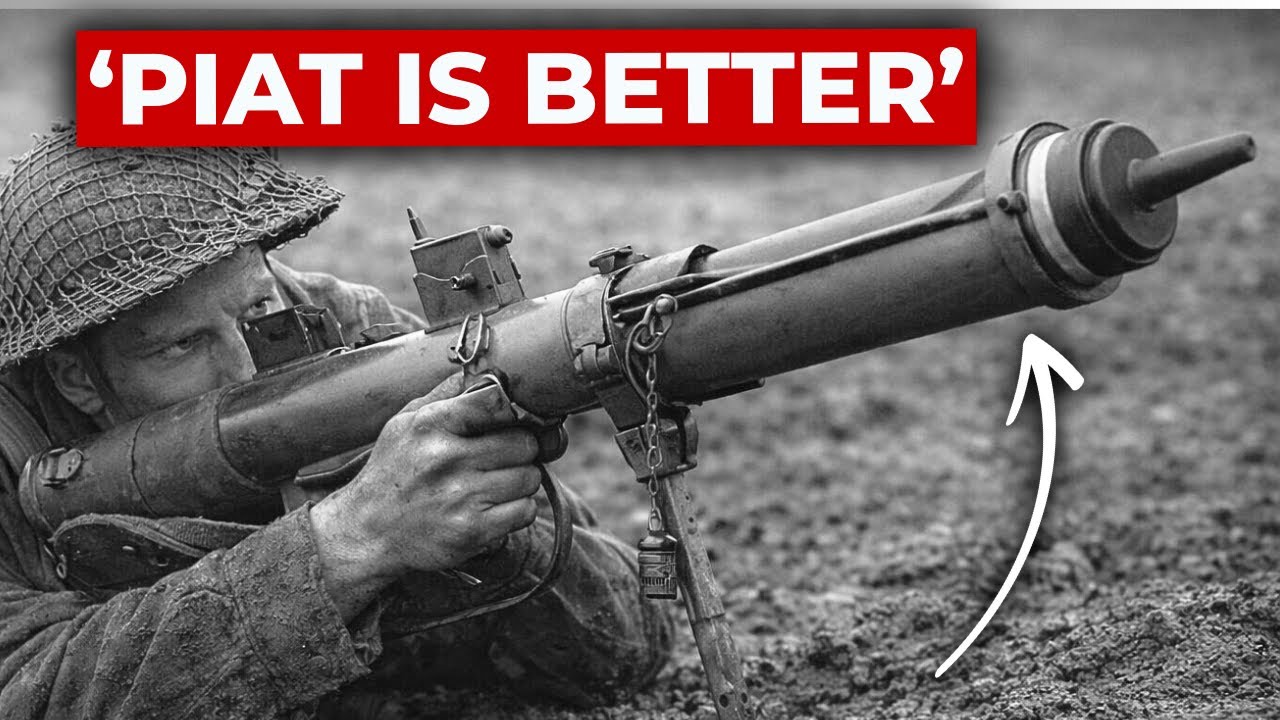
On September 20th, 1944, a Piet bomb detonated prematurely in his face, temporarily blinding him. While being dragged to safety, witnesses reported him screaming for someone to grab the pit. His sight returned after 30 minutes. He refused evacuation. Both eardrums burst from constant firing. He stuffed field dressings in his ears and continued fighting.
Private Ernest Smokeoky Smith earned his Victoria Cross at the Savvio River in Italy in October 1944. Leading a Piet team across open ground under fire from three Panthers, two self-propelled guns, and 30 infantry, Smith engaged the lead Panther at 30 ft and destroyed it. When 10 German infantry charged him with schmicers, he killed four with his Thompson submachine gun and drove back the rest while protecting his wounded comrade.
Sergeant Wagger Thornton of the Ox and Bucks light infantry, famous for the Pegasus bridge assault, offered a harsher assessment despite these successes. He called the Piet a load of rubbish, claiming the realistic range was around 50 yard and no more. He added a critical warning. You must never miss. If you do, you have had it because by the time you reload the thing and it, which is a bloody chore on its own, everything is gone. You are done.
The recoil was legendary. One soldier in Italy shot at a Panther while standing and was completely knocked over despite scoring a hit. The 12 lb spigot lurching forward a tenth of a second before firing made accurate aiming difficult. Soldiers learned to brace themselves, to fire from prone positions whenever possible, and to accept that operating the weapon was a physical ordeal.
The bazooka’s combat record proved more troubled. The M1 first saw action during Operation Torch in November 1942, but training had been rushed and results were poor. An American general visiting Tunisia afterward could not find any soldiers who could report that the weapon had actually stopped an enemy tank. By May 1943, further M1 Bazooka issue was suspended due to the unreliable M6 rocket.
The batterypowered ignition system created constant problems. In humid conditions, the contacts corroded. In salt air, they failed. In cold weather, the rocket propellant did not fully burn inside the tube, extending past the muzzle and increasing danger to the operator. Bazooka operators faced high risk at the close ranges the weapon required.
The back blast revealed their position immediately and reloading under fire was difficult. General Patton himself was blunt about the weapons limitations. He stated that the purpose of the bazooka is not to hunt tanks offensively, but to be used as a last resort. He recommended the range should be held to around 30 yard. At that distance, against a moving tank, survival was unlikely regardless of whether you hit or missed.
Both weapons struggled against heavy German armor. By 1943, Germany had deployed Schuen, armored side skirts originally introduced to counter anti-tank rifles. These skirts also provided some protection against hollow charge weapons by creating standoff distance and sometimes causing premature detonation. A 1943 US intelligence bulletin confirmed the 2.
36 in bazooka-shaped charge could not penetrate Tiger frontal armor. The Pat faced identical problems. Both weapons required flanking shots against heavy armor, dangerous work at close engagement ranges. The Germans captured and studied bazookas in Tunisia and quickly recognized the concept’s value.
By late 1943, they had fielded the Panzer Shrek, essentially a scaled up bazooka with an 88 mm warhead capable of penetrating around 160 mm of armor superior to the American original. American intelligence called the Panzer Shrek clumsier than the bazooka and reputedly less accurate, but its hitting power was undeniable, and American troops who encountered captured German anti-tank weapons sometimes preferred them to their issued bazookas.
Korea exposed the bazooka’s inadequacy definitively. At the Battle of Osan on July 5th, 1950, Second Lieutenant Ole Connor maneuvered to close range behind a T-3485 tank, targeting its weakest armor and fired 22 bazooka rockets with little effect. The urgent development of the M20 Super Bazooka, a 3.5 in design, was the direct result.
The spigot mortar concept died with the Pat. No successor was developed. The design was too heavy, too complex, and too limited in range to justify continuation. The Pat served through the Korean War before retirement in the early 1950s when the British Army adopted the American M20 Super Bazooka as its replacement.
The bazooka’s lineage, by contrast, runs directly to modern weapons. Germany’s Panzer Shrek, essentially a scaled up copy of the captured American design, influenced postwar development. Soviet designers combined bazooka reloadability with panserfouse warhead concepts to create the RPG2 in 1949 and eventually the RPG7 in 1961.
The most widely used anti-tank weapon in history. The M72, Law, AT4, NL AW, and Javelin all trace their ancestry to the shoulder fired shaped charge concept the bazooka pioneered. Britain’s decision was not about national pride. The timeline reveals pragmatic calculation. The pat was already in production when bazookas arrived for evaluation.
British manufacturing capacity was committed. More importantly, British tactical doctrine anticipated the urban combat, defensive positions, and concealment requirements where the pet excelled for fighting in buildings, from trenches, and in close terrain. Zero back blast was not merely an advantage. It was survival. The numbers validate the choice.
7% of German tanks destroyed by British forces in the critical early overlord period fell to patims. Six Victoria crosses. Over 115,000 units produced. A Canadian Army survey naming it the most effective infantry weapon of the war. Against these results, the bazooka offered lighter weight and easier operation. Meaningful advantages that did not outweigh the Piet’s tactical flexibility in British hands.
The Piet was an evolutionary dead end. The bazooka was an ancestor, but in the brutal fighting of 1943 to 1945, the weapon that mattered was the one that worked when you needed it. For British soldiers fighting in the hedge of Normandy and the ruins of Arnum, that weapon was the crude, heavy, shoulder bruising pat, Britain said no to America’s bazooka because British engineers had already built something better suited to British needs.
The combat record proved them right.
News
Why the Viet Cong Feared the SAS More Than Any American Unit
Fuaktui Province, South Vietnam, March 17th, 1966. The Vietkong sentry never heard them coming. Nuan Vanam had survived 2…
They Mocked His “Backwards” Loading Method — Until His Sherman Destroyed 4 Panzers in 6 Minutes D
At 11:23 a.m. on September 19th, 1944, Private First Class Walter Kowalsski crouched inside his M4 Sherman tank near…
The Most Insane Helicopter Pilot of Vietnam – Ace Cozzalio D
Oh, good girl. You want to hear the story about the deadliest IHOP employee to have ever existed? Yeah….
Why American Soldiers Started Killing Their Own Officers in Vietnam D
Today’s video is brought to you by the good people over at AG1. I told myself I wasn’t doing…
How Canadians Stood Up for Black GIs After U.S. MPs Crossed the Line D
July 1944, Aldershot, England. The summer air hung thick and warm inside the Red Lion Pub. Canadian soldiers sat…
The Ugly Gun That Beat the Beautiful Thompson: M3 Grease Gun’s WWII Revolution D
October 1942, a General Motors Inland Division in Dayton, Ohio, George Hyde, a 52-year-old immigrant from Germany, was completely…
End of content
No more pages to load