Avoid Australian patrols, they said. They are too quiet. They appear behind you. These weren’t American assessments. These weren’t political speeches. These were warnings written by the Vietkong themselves. Warnings about an enemy they couldn’t predict, couldn’t hear, and couldn’t escape.
Australian diggers became the most feared infantrymen in the Vietnam War. And today, we’ll finally explore why. By the time Australia sent troops to Vietnam in 1965, its infantry already carried something most armies didn’t. A lineage of jungle warfare stretching back decades. They’d fought in the Pacific during World War II.
They’d patrolled the rubber plantations of Malaya during the emergency. They’d hunted communist insurgents through the mountains of Borneo, and they’d learned. But it wasn’t just training. It was culture. Australian soldiers were grounded, practical. They didn’t need motivational speeches or glory. They needed to get the job done, look after their mates, and get home.
Bushcraft wasn’t foreign to them. Reading terrain, moving quietly, surviving on little. These were skills that came naturally to men raised in the Australian outback and bush. The army simply refined what was already there. They brought something else, too. an attitude. No fuss, no noise. Get it done.
While other armies talked about tactics, Australians just applied them quietly, efficiently, lethally. This made them different from the start. But what made them feared was something else entirely. The Vietkong kept records, intelligence assessments, afteraction reports, and in those documents, a pattern emerged. Australian patrols were flagged as high priority threats.
Areas where Australians operated were marked as dangerous. VC commanders warned their units. Avoid contact with the Australians if possible. Why? Because Australians moved through the jungle like ghosts. American patrols could be heard from hundreds of meters away. Equipment rattling, voices carrying, boots crashing through undergrowth.
The VC could track them, predict them, ambush them. But the Australians, they were silent. A patrol of 12 men could move within meters of a VC position without being detected. They used hand signals instead of radios. They moved slowly, deliberately, reading every broken twig and disturbed leaf. They didn’t walk into ambushes.
They found them first. And that terrified the enemy. The VC were masters of guerrilla warfare. They’d beaten the French. They were bleeding the Americans, but the Australians fought like they did. Small patrols, patient, invisible. The VC couldn’t use their own tactics against an enemy who’d already mastered them.
There’s a deeper truth here, one that Australians rarely heard during the war, and many still don’t know today. The Vietkong didn’t just avoid Australian patrols out of caution. They avoided them out of respect. Professional respect. The kind one skilled fighter gives another. Australian soldiers patrolled where others didn’t.
Deep into VC controlled areas, through terrain so dense it swallowed sound and light. They set ambushes in places the enemy thought were safe. They tracked movements other units never saw. And when contact came, they didn’t panic. They didn’t spray bullets wildly into the jungle. They fired controlled bursts, flanked the enemy position, called artillery with pinpoint accuracy, then vanished before reinforcements arrived.
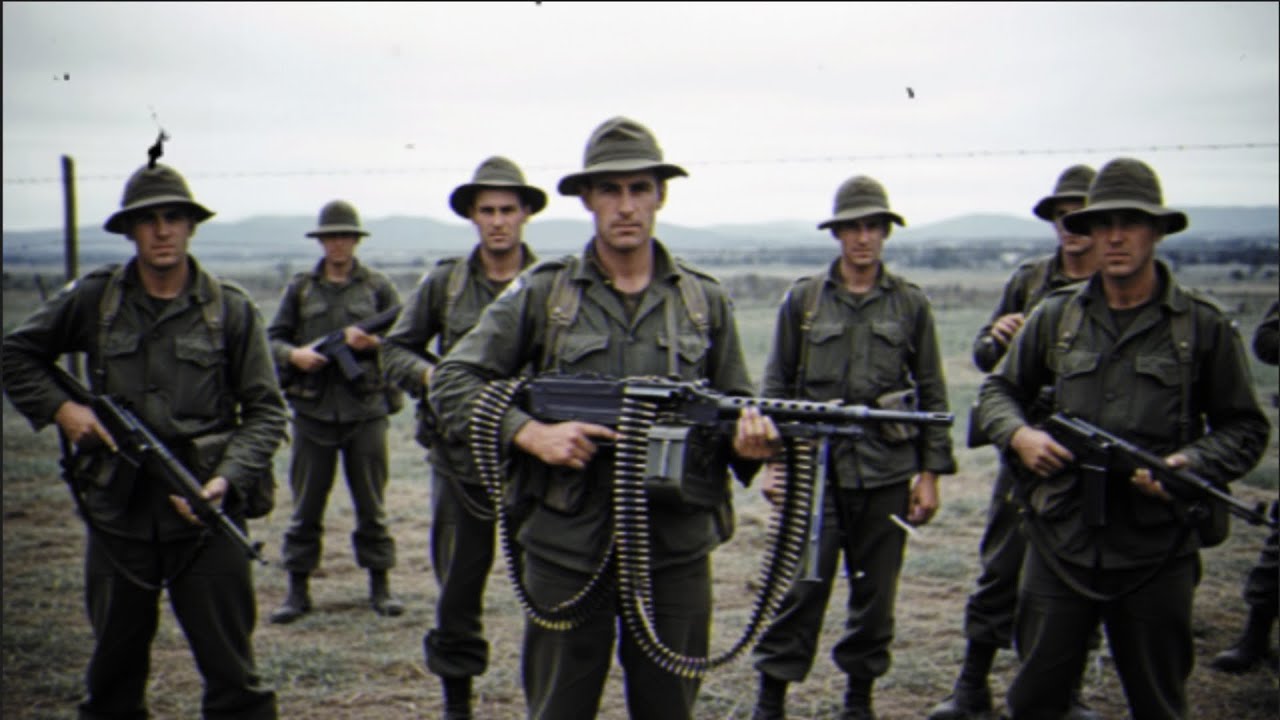
This wasn’t luck. It wasn’t aggression. It was mastery. Mastery of the jungle, of silence, of control, and of themselves. But here’s what most people don’t understand. Being feared wasn’t about brutality. It was about being better. And that reputation came at a cost Australians rarely see. To understand why the Vietkong feared Australian diggers, you need to understand how they actually operated, not the Hollywood version, the real thing.
An Australian patrol was typically 10 to 12 men, sometimes fewer. Each man carried up to 40 kg of equipment, ammunition, water, and rations. They’d patrol for days, sometimes weeks, deep in enemy territory with no support. The spacing was critical. 20 to 30 m between each man. Far enough that a single burst of fire couldn’t hit multiple soldiers close enough to maintain visual contact through thick jungle.
There was zero talking. None. Communication was done entirely through hand signals. A closed fist meant stop. Pointing meant enemy sighting. Tapping the rifle meant danger close. Every man had a sector of responsibility. arcs of fire that overlapped but never crossed. If contact came from the left, specific soldiers would engage, while others covered flanks and rear.
No one had to think about it. It was drilled until it was instinct. They moved slowly, painfully slowly, sometimes covering just one kilometer in an hour. The point man would check every step before putting weight down, looking for trip wires, listening for movement, watching for disturbed vegetation that meant someone had passed recently.
Behind him, the scout would observe from a different angle. Two sets of eyes, two interpretations of the same terrain, then the patrol commander, then riflemen, then the machine gunner, then more riflemen. Finally, the quote one eyes walking backwards, watching their rear. Anti-tracking was constant. They’d move through streams when possible, step on rocks and logs to avoid leaving prints, brush out boot marks when crossing soft ground, double back on their own trail to catch anyone following them.
And the discipline, the absolute discipline. No one lit a cigarette. No one coughed unnecessarily. Weapons were kept unsafe until contact was imminent. Magazines were taped together jungle style, but checked constantly for dirt and moisture. This level of operational security made them nearly impossible to ambush. The VC would set up a killing zone, wait for hours in the stifling heat, only to watch as an Australian patrol spotted the signs and melted back into the jungle without a sound.
Or worse, the Australians would spot the ambush, quietly flank it, and hit the VC from behind. Imagine being a Vietkong fighter. You’re dug into a position you’ve used successfully against American units. You’re waiting, confident. Then you hear a single suppressed cough behind you. You turn and there’s an Australian soldier rifle raised less than 10 meters away.
You never heard him coming. That’s why they were feared. But the tactical excellence was only part of it. The real edge, the thing that made Australian soldiers unstoppable was their mindset. They were calm under fire. Not reckless, not fearless, just calm. When rounds started cracking overhead, when the jungle erupted in noise and confusion, Australian soldiers slowed down, they assessed.
They reacted with precision, not panic. There was dark humor, too. The kind that keeps you sane when nothing else will. Bloss joking quietly while waiting for a medevac, taking the piss out of each other during a mortar barrage. It wasn’t bravado. It was a release valve. A way to stay human when everything around you was trying to strip that away.
And there was trust, absolute trust in your mates. You didn’t have to watch your own back because you knew someone else was. You didn’t question whether your section would come for you if you went down. They would always. This trust created something extraordinary. A section of Australian soldiers didn’t fight as individuals. They fought as one organism.
Every man knew what the others would do before they did it. Movements were synchronized without commands. Fire was coordinated without shouting. The combat doctrine reflected this. Precision over aggression, controlled bursts, not fully automatic fire, aimed shots, not suppressive spray. Australian soldiers were trained to make every round count. And they did.
When contact happened, it followed a pattern. First, someone would spot the signs. Maybe disturbed earth, maybe a smell on the wind. Maybe just a feeling. The patrol would freeze. Hand signals would ripple down the line. Every man would sink into cover without a sound. The commander would assess, is this an ambush, a patrol, a base camp? Are we in the killing zone or outside it? Do we have the advantage? If they were in danger, they’d execute a break contact drill, suppressing fire from designated riflemen while others pulled back by
bounds. smoke grenades for concealment, then gone. Vanished into the jungle before the enemy could organize a pursuit. But if they had the advantage, that’s when it got terrifying for the VC. Australian soldiers would flank, not frontally assault, not call in air strikes and wait. They’d flank. One section would fix the enemy with accurate fire, while another moved silently through the jungle to hit them from the side or rear.
The VC would suddenly find themselves taking fire from an unexpected direction. They’d try to reorient, but by then, artillery would be falling. Called in by a forward observer who’d calculated the grid reference without a map, just from terrain recognition and pace counting. 30 seconds later, the Australians would be gone, moving swiftly now, putting distance between themselves and the contact site before VC reinforcements could arrive.
Clean, efficient, professional. This is what made them different. This is what made them feared. Not size or firepower or technology. Skill. Pure, undeniable skill. But skill alone didn’t create fear. It was what they endured that completed the picture. Here’s the part that’s hard to talk about. The part that Australians who never served don’t always understand.
Being the best made Australian soldiers the first choice for the worst jobs. They got the deep patrols, the long range reconnaissance missions that took them days into enemy controlled territory with no backup. They got the zones other units wouldn’t go into the areas so thick with VC that inserting a larger force was considered suicide. They got sent to fix problems.
When a region was too hot, when ambushes were becoming too frequent, when intelligence needed updating, Australian infantry went in and they were expected to succeed. Every time there was minimal support, while American units could call in helicopter gunships, artillery, and tactical air support within minutes, Australian patrols were often too deep for that. They were on their own.
If something went wrong, they’d have to fight their way out with just what they carried. This created enormous pressure. Physical pressure from the weight, the heat, the constant movement through hostile terrain. But worse was the psychological pressure. You couldn’t relax ever. Every moment in the jungle required hypervigilance.
Is that leaf disturbed naturally or did someone brush past it? Is that bird call real or a VC signal? Is the jungle quieter than it should be? Sleep came in snatches. 30inut rotations where you try to rest while your mates kept watch. But real sleep, deep sleep, that didn’t happen for weeks at a time. You were wet constantly from rain, from sweat, from crossing streams.
Your skin would soften and split. Jungle rot would set in. Leeches would attach themselves while you were moving, and you couldn’t stop to remove them until the patrol halted. The weight destroyed your body. Shoulders were rubbed raw by pack straps. Knees took punishment from moving slowly while carrying 40 kg. Feet developed trench foot from being wet inside boots for days. And the hunger.
Rations were minimal because weight was a factor. You’d lose kilograms on every patrol, come back gaunt and exhausted only to be sent out again after a few days rest. But none of that was the hardest part. The hardest part was the responsibility. Australian soldiers didn’t fear dying. They feared letting their mates down.
That’s what kept them awake at night. That’s what made them push beyond exhaustion. The thought that if they missed something, if they weren’t alert enough, if they made one mistake, their mates would pay the price. This created a silent weight, a burden carried individually, but shared collectively. When someone was wounded, you carried them.
Not just their weight, but their weapon, their ammunition, their pack. Through jungles so thick you could barely move unencumbered. You carried them for kilome if necessary until you reached an extraction point or a clearing where a helicopter could land. And you kept going. Even when your shoulders were screaming. Even when your legs were shaking from exhaustion.
Even when you didn’t know if you could take another step, you carried them because they would carry you. There are stories, quiet stories that veterans don’t often tell. Of patrols continuing even after men collapsed from heat exhaustion. Of soldiers with untreated wounds staying on patrol because pulling out would compromise the mission.
of men pushing themselves so far past their limits that they had nothing left when they finally got back to base. This wasn’t bravado. It wasn’t trying to be a hero. It was simpler than that. It was mathip. That word gets used casually in Australia, thrown around in sports and pubs and workplaces. But in the jungle, it meant something deeper, something absolute. Your mates were everything.
They were the only people who understood what you were going through. The only ones you could trust completely. The only ones who would come for you no matter what. That bond created warriors who wouldn’t quit. Who couldn’t quit? Because quitting meant abandoning your mates. And that was unthinkable. But excellence came with a cost that lasted far beyond the war.
The constant vigilance, the hyper awareness that kept you alive in the jungle. It didn’t turn off when you came home. It stayed with you for years, for decades. Veterans would wake up at night, heart pounding, convinced they’d heard movement outside. They’d position themselves in rooms so they could see all exits.
They’d avoid crowds because too many people in close proximity felt dangerous. The silence they’d mastered became a cage. Many couldn’t talk about what they’d experienced, not because of some code of secrecy, but because there were no words that could make someone who wasn’t there understand. And the guilt, survivors guilt.
Why did I make it home when others didn’t? Why was I on leave when my patrol got hit? Why did that bullet miss me and take my mate instead? These questions didn’t have answers, but they echoed for decades. This was the price. the real price. Not the physical scars, though those were real enough, but the psychological toll of being excellent at something that required you to live on the edge of survival for months at a time.
Being feared was a weapon, but it was also a weight they carried long after the war ended. And when they came home, that weight got heavier. Picture this. You’ve spent months in the jungle, moving silently with men who die for you without hesitation, executing missions with precision, being part of something that demanded everything you had and proved you were capable of giving it.
Then you come home. It’s the late 60s, early 70s. The war is unpopular. Protesters are calling soldiers baby killers. The media is showing only the ugliest parts of the conflict. You don’t get a parade. You get silence. You’re told not to wear your uniform in public because it might provoke confrontations.
Friends don’t know how to talk to you. Employers don’t want to hire veterans because there’s a stigma that you’re damaged, violent, unstable. So, you hide it. You put away the uniform, don’t mention your service, and try to blend back into a society that doesn’t want to acknowledge what you did or what it cost you.
For many Australian Vietnam veterans, the silence was worse than the jungle. In the jungle, at least your purpose was clear. Your mates understood you. Your skills had value. You knew who you were. But back home, you were just another bloke trying to find work and make sense of life.
Except you were carrying things no one else could see. the nightmares, the hyper vigilance, the inability to relax, the reflexive reactions to loud noises, the difficulty forming close relationships because you’d lost mates and some part of you didn’t want to risk that kind of loss again. There was no support system. Post-traumatic stress disorder wasn’t widely recognized yet.
The term or quote forebeings from previous wars was considered weakness. Real men were supposed to just get on with it. So, they did. They got on with it. They found jobs, started families, built lives, but they did it while carrying wounds that never healed properly because no one knew how to treat them. Many felt abandoned.
They’d served their country with distinction. They’d done everything asked of them and more. They’d fought with honor and professionalism, and their country turned its back on them. It took years, decades really, before Australia began to understand what it had done to its Vietnam veterans. before recognition came, before proper support was available.
But something else was happening during those years, something the Australian public never knew. While Australian veterans were struggling with silence and indifference at home, military professionals around the world were studying what they’d accomplished in Vietnam. American military analysts were examining Australian patrol techniques.
They’d noticed the dramatically lower casualty rates, the higher success rates on reconnaissance missions, the effectiveness of Australian ambushes. Reports were written, studies were conducted, training manuals were revised. The Australian approach to jungle warfare, the tactics that had made their infantry so feared, was being adopted by other nations.
British forces incorporated Australian patrol methods. American special operations units studied Australian movement techniques and noise discipline. Armies across Southeast Asia examined Australian doctrine. Because what Australian soldiers had done in Vietnam wasn’t just effective, it was exceptional. They’d taken infantry warfare and refined it to a level that others struggled to match.
The combination of skill, discipline, patience, and judgment that Australian patrols demonstrated became a blueprint for modern infantry operations. But the Australian public didn’t know this. They didn’t know that their soldiers, the ones struggling quietly with memories and wounds, had set a standard that military professionals worldwide recognized as outstanding.
They didn’t know that Australian infantry doctrine was secretly admired internationally. that when military experts talked about effective small unit tactics, they referenced Australian operations in Fuoktui province, they didn’t know their sons and brothers and fathers had fought with an excellence that few armies ever achieve until slowly the recognition began to come. Veterans groups formed.
They pushed for acknowledgement, for proper commemoration, for support systems. And gradually Australia listened. Welcome home marches were held. Memorials were built. The phrase quote five began to include Vietnam veterans alongside those from previous wars. It wasn’t perfect. It couldn’t undo the years of silence.
But it was something. And more than that, a truth began to emerge. A truth that the Vietkong had known all along. Australian soldiers in Vietnam were among the finest infantry men of their generation. Not because of propaganda or nationalism or exaggeration, but because of measurable, demonstrable excellence in the most demanding environment imaginable.
Today, that legacy continues. Modern Australian infantry still trains on the principles forged in Vietnam. The emphasis on patrol discipline, noise control, and tactical patience didn’t disappear when the war ended. It was codified, passed down, refined further. Australian Special Air Service Regiment and Commandos carry lessons born in Fuaktui Province.
The ability to operate in small teams deep in hostile territory. The patience to wait hours or days for the right moment. The discipline to maintain silence and precision under extreme stress. These weren’t skills invented in recent decades. They were inherited from diggers who patrolled the jungles of Vietnam and proved they worked.
When Australian special forces deploy today, whether it’s Afghanistan, Iraq, or anywhere else, they’re building on a foundation laid by infantrymen who faced an enemy that had defeated colonial powers and was challenging a superpower. And they honor that legacy not with speeches or ceremonies, though those happen, but by maintaining the same standards, the same discipline, the same quiet professionalism, because that’s what Australian military culture does.
It remembers not loudly or boastfully, but in the way it trains, operates, and conducts itself. The Australian Army is known globally for precision patrolling, for tactical patience, for the ability of small units to operate independently with devastating effectiveness. That reputation was earned in the jungle by men who made themselves masters of their environment and their craft.
Australia eventually learned the truth. Its sons fought with unmatched discipline and honor, and that truth is finally taking its rightful place in the nation’s understanding of its military history. So why did the Vietkong fear Australian diggers more than any other infantry? The answer is simpler than you might think. No mythology needed.
No exaggeration, just the facts. They were silent. While other patrols announced their presence, Australians moved through the jungle like they’d been born there. The Vietkong couldn’t hear them coming and couldn’t track them leaving. They were disciplined. Every man knew his role. Every action was controlled.
There was no panic, no confusion, no wasted effort. Just professional soldiers executing practice drills with precision. They were patient. Australian soldiers wouldn’t rush into contact. They’d wait, observe, choose their moment, and when they acted, it was with complete surprise and overwhelming advantage.
They had tracking skills that matched the enemy’s own. They could read signs in the jungle that others missed, determine how many men had passed, how recently, where they were heading. This turned the tables on an enemy that relied on stealth and mobility. They were accurate. Australian soldiers didn’t waste ammunition. They aimed. They fired controlled bursts and they hit what they aimed at.
This made their firepower more effective despite often being outnumbered. They could operate independently. Small Australian patrols made decisions in the field without needing constant guidance from headquarters. They adapted to situations, used initiative, and took responsibility for outcomes. And above all, they had matesship, that uniquely Australian bond that turned individual soldiers into something greater.
They fought not just for their country or their cause, but for each other. And that made them unstoppable. This wasn’t myth. It was measured. The afteraction reports prove it. The casualty statistics prove it. The enemy’s own documents prove it. Australian infantry in Vietnam achieved a level of operational excellence that stands as one of the finest examples of small unit warfare in modern military history.
But behind that excellence were men. Real men. Young men. Most of them. Men who left Australia not knowing what they’d face or what it would cost them. They were tough. They had to be. But they were also human. They felt fear. They dealt with loss. They struggled with what they saw and did. They were humble. They didn’t ask for medals or recognition.
Most just wanted to do their job, look after their mates, and get home safely. They had a sense of humor, that dry, self-deprecating Australian wit that found comedy even in the darkest moments. It kept them sane, kept them connected to who they were before the war tried to change them. They were practical.
They didn’t romanticize combat. They didn’t pretend it was anything other than hard, dangerous, exhausting work that someone had to do. And they were loyal. Loyal to their mates above everything else. That loyalty drove them to extraordinary acts of courage. Not the Hollywood kind, but the quiet kind. Staying alert on watch even when exhausted.
Carrying extra ammunition for a mate whose pack was too heavy. Moving toward gunfire because your section was in contact. These weren’t superheroes. They were ordinary Australian BS who rose to extraordinary circumstances through skill, training, and character. They came from cities and country towns from wealthy families and working-class backgrounds.
Some were regular army soldiers who joined seeking adventure or purpose. Others were national servicemen conscripted through a lottery system who’d never planned on military service. But in the jungle, those differences didn’t matter. You were judged on whether you could do the job and whether your mates could trust you. Nothing else.
And they did the job for years under conditions most people can’t imagine. with professionalism that earned respect from enemies and allies alike. But here’s what matters most. What should be remembered above tactics and statistics and military analysis. They were your countrymen, sons of Australia who served when called, who endured hardships most of us will never face, who lost mates, who came home changed by what they’d experienced.
They didn’t ask to be feared. They didn’t seek a reputation. They just did what Australian soldiers have always done. They showed up. They did their duty. They looked after their mates. And in doing so, they became legends. Not because they wanted to be, but because they were simply that
News
“I Could Not Stand”, German Woman POW Weeps When Americans Lift Her Instead
The ground is cold and uneven. Mud clings to boots and hems. Smoke hangs low and smells of burned oil…
“I Expected Screaming”, German Woman POW Stunned by the Silence of American Camps
The train slows in the gray dawn. Frost clings to the wooden planks of the cattle car. The door slides…
“Get These Clowns Out of My Camp”—Why US Command Mocked the SAS Death-Smell Until They BURIED the VC
Get these clowns out of my camp. That is the exact phrase an American colonel used to describe Australian SAS…
Wounded in Vietnam during TET 1968| Don Kaiser’s Story of War, Brotherhood, and Survival.
firing had gotten so intense it was just breaking rice straws off in front of front of our faces. You…
“We Were Starving”, German Women POWs Shocked by American Soup Pots
Late April 1945, a thin mist hangs over a shattered German town. Broken roofs drip from the night rain. A…
The Darkest Secret of Nazi Germany: The Breeding Program That Even Hitler Feared
You remember those old grainy documentaries, the ones that detail the darkest corners of the Third Reich? We often talk…
End of content
No more pages to load