
Sen. Gallego Drops Bombshell on Bessent’s Alleged Plan to Funnel $10B to Trump
“The Most Brazen Self-Dealing Scheme in History”: Senator Ruben Gallego Exposes $10 Billion Taxpayer Payoff Plan to Donald Trump
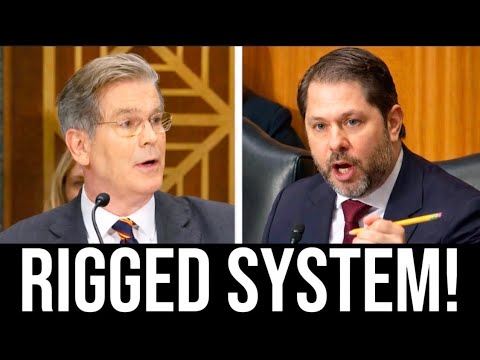
In the hallowed halls of the Dirksen Senate Office Building, a scene unfolded this week that felt less like a standard government oversight hearing and more like the unraveling of a high-stakes financial heist. Senator Ruben Gallego of Arizona sat across from the newly minted Treasury Secretary, Scott Bessent, and systematically dismantled what critics are calling a multi-billion-dollar “shakedown” of the American taxpayer. At the heart of the controversy is a $10 billion lawsuit filed by President Donald Trump against his own government—a lawsuit that his own appointees will decide whether to settle, and his own Treasury Secretary will be responsible for paying.

The exchange, which has since gone viral, highlights a staggering conflict of interest that appears to bypass every traditional safeguard in the American legal and financial system. As Secretary Bessent attempted to portray himself as a mere “paymaster” following the law, Senator Gallego painted a much darker picture: a sitting president using the machinery of the state to extract a massive personal windfall from the people he was elected to serve.
The $10 Billion “Shakedown”
The premise of the lawsuit is as unusual as the figures involved. Donald Trump is seeking at least $10 billion in damages from the Internal Revenue Service (IRS) and the Treasury Department—agencies he currently oversees—due to the unauthorized disclosure of his tax returns by a federal contractor . While the leak was undeniably a crime, for which the perpetrator, Charles Littlejohn, is currently serving a five-year prison sentence, the legal and ethical questions surrounding the $10 billion claim are immense.
Senator Gallego’s questioning focused on the mechanics of how this money would actually change hands. “You are fully aware that the president is suing your agency for $10 billion,” Gallego began, noting that Bessent is currently serving as both Treasury Secretary and acting director of the IRS . When asked where that money would come from, Bessent admitted it would be drawn from the Treasury General Account—effectively, the collective tax dollars of the American people .
The Conflict of Interest: A “Passive Robot” in the Treasury
The most alarming aspect of the hearing was Secretary Bessent’s insistence that he has no independence or judgment in the matter. Throughout the interrogation, Bessent repeatedly claimed that he is merely a “paymaster” and that any decision to settle or pay the claim rests entirely with the Department of Justice (DOJ) .
However, as Senator Gallego pointed out, the DOJ is currently run by Attorney General Pam Bondi, another Trump appointee. This creates a closed loop of loyalty: a Trump appointee at the DOJ decides to settle a case with Trump, and a Trump appointee at the Treasury writes the check to Trump. “Do you work for the president of the United States?” Gallego asked pointedly. “I work for the American people,” Bessent replied, though he was forced to admit seconds later that the president has the full power to fire him at any time .
This “firing power” is the invisible string attached to every decision made in this process. Critics argue that Bessent’s claim of being a “passive robot” who must follow the law is a convenient fiction designed to mask an abdication of responsibility. Under federal regulations (31 CFR section 256.1), the Treasury is actually required to verify that a settlement or judgment is “proper” before authorizing payment from the Judgment Fund . By claiming he has no say, Bessent is effectively signaling that he will not exercise the oversight duties inherent in his office if they conflict with his boss’s financial interests.
Suing for His Own Failures
The timeline of the tax leaks adds another layer of absurdity to the $10 billion claim. The disclosures occurred between May 2019 and September 2020—during Donald Trump’s first term as president . At that time, the Treasury was run by Steven Mnuchin and the IRS by Charles Rettig, both of whom were Trump appointees. In essence, the president is suing the government for a security failure that happened under his own administration’s watch.
Senators Ron Wyden and Elizabeth Warren have raised this exact point in formal letters, noting that the president is “suing the government for his own failures during his first term” . Furthermore, legal experts have questioned the $10 billion figure itself. To win such an amount, Trump would have to prove $10 billion in “actual damages” to his reputation or business. Yet, since his re-election, his family business has continued to ink massive international deals, suggesting that the “reputational harm” from his $750 tax bill being made public has had little to no impact on his bottom line .
The Price of a “Bizarro World”
If the $10 billion payment is authorized, it will represent the single largest payout to an individual in the history of the Treasury Judgment Fund. To put that number in perspective, $10 billion is more than the entire annual budget for many federal agencies. It is money that could be used for infrastructure, education, or veterans’ benefits. Instead, it would move directly from the Treasury General Account into the personal pockets of the man who oversees that account .
“If this had been happening in any other country, it would look like a total shakedown,” Gallego remarked during the hearing . The lack of recusal from Secretary Bessent, coupled with his ongoing personal litigation with the IRS over his own $1 million tax bill, has created an environment where public trust in the Treasury is at a historic low .
Conclusion: A Daring Challenge to the Law
The Senate Banking Committee hearing has left the American public with a chilling realization: the traditional checks and balances designed to prevent self-dealing are being openly challenged. Secretary Bessent’s refusal to acknowledge the conflict of interest, or to commit to any independent review of the president’s claim, suggests that the administration is no longer even pretending to follow ethical norms.
As the lawsuit moves through the Southern District of Florida, the eyes of the nation are on the Treasury. Will Scott Bessent act as a guardian of the American taxpayer, or will he simply hit “send” on the most expensive wire transfer in history? As Senator Gallego concluded, “You’re not obeying the law; you’re plundering US taxpayer dollars” . The “shakedown” is in progress, and the bill is being sent to you.
News

New Message Sent to Nancy Guthrie’s Alleged Kidnappers — But Are the Ransom Notes Real?
Mystery Deepens: Family Sends New Plea as Ransom Note Claims Face Scrutiny The quiet suburbs of Tucson, Arizona, remain at…
WATCH: Karoline Leavitt Slams Democrats After Deadly Indiana Case
WATCH: Leavitt Sparks Debate After Responding to Indiana Crime Case “Lowest Murder Rate Since 1900”: Karoline Leavitt Slams “Democrat Chaos”…

“You’re Going to Jail” — Sha’Carri Richardson’s 104 MPH Traffic Stop Goes Viral
Olympic Star Sha’Carri Richardson Faces Legal Trouble After High-Speed Stop “Wipe That Smile Off Your Face”: Olympic Gold Medalist Sha’Carri…

DL Hughley Speaks Out on Nicki Minaj’s MAGA Controversy in Blunt New Statement
DL Hughley Breaks Silence on Nicki Minaj’s Politics as Backlash Grows “Embarrassing Last-Second Save”: How Nicki Minaj Scrambled to Pay…

ICE Encounter Turns Violent: U.S. Citizen Shares Terrifying Story of Shots Fired at His Family
“I Thought We’d Be Killed” — Martin Rascon Recounts Federal Agents Shooting at His Car “Three Minutes That Changed Our…

Billie Eilish Faces Public Backlash After Grammys Comments Spark Outrage
Billie Eilish Faces Public Backlash After Grammys Comments Spark Outrage In the quiet, pre-dawn hours of a Tuesday morning that…
End of content
No more pages to load